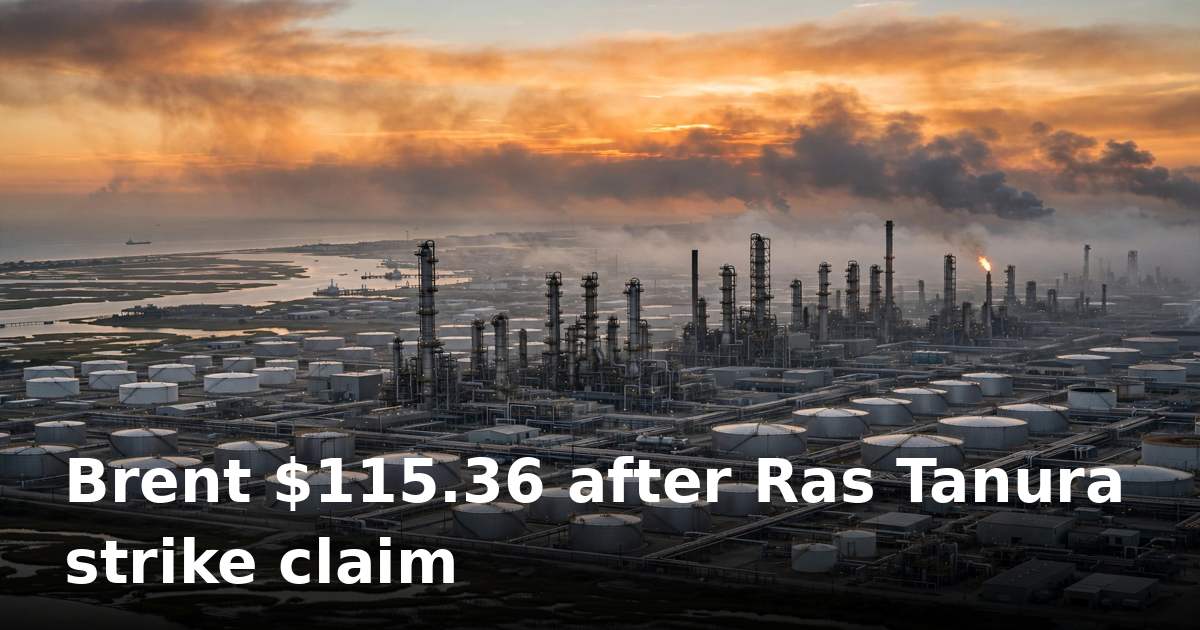

Brent crude futures gained $1.48, or 1.3%, to $115.36 a barrel at 0140 GMT on Wednesday, October 28. US West Texas Intermediate added $1.22, or 1.22%, to $101.12. Both figures come from Reuters. The trigger was a Tuesday claim by Yemen's Houthis: a missile hit Ras Tanura, Saudi Arabia's largest refinery. Riyadh issued no immediate confirmation. Reuters also reported no immediate detail on damage or any halt to operations.
The market priced a headline, not a confirmed outage.
Tuesday ran the other way. Brent settled at $113.88, down $1.93 or 1.67%. WTI settled at $99.90, down $1.86 or 1.83%. Middle East talks had eased supply worries, per Reuters reporting carried by AsiaOne. Wednesday's rebound won back $1.48 of Brent's $1.93 Tuesday loss. It won back $1.22 of WTI's $1.86 loss. WTI moved back above $100. MarketRadar's snapshot at 0329 UTC put WTI at $101.2, up 1.3%. That matches the Reuters 0140 GMT read. The Brent-WTI spread widened $0.26, to $14.24 from $13.98 at Tuesday's settles.
| Benchmark | Tuesday settle, Oct 27 | Wednesday 0140 GMT, Oct 28 | Change |
|---|---|---|---|
| Brent crude | $113.88 (-1.67%) | $115.36 (+1.3%) | +$1.48 |
| WTI crude | $99.90 (-1.83%) | $101.12 (+1.22%) | +$1.22 |
| Brent-WTI spread | $13.98 | $14.24 | +$0.26 |
Why it matters
Ras Tanura pairs refining capacity with an export terminal. A hit there feeds two channels at once: refined-product supply, led by diesel, and crude loadings from the country that exports more crude than any other. A refinery outage bites products first. That is why traders watch for Saudi confirmation more than for the claim itself. Gelber & Associates analysts put the tension in one sentence: "Continued Houthi attacks on Saudi Arabia and the expanding military presence in the Gulf are keeping supply risks in place, even as diplomatic headlines encourage some of the recent premium to unwind." The diplomatic headlines behind Tuesday's fall included talks in Tehran. Iranian officials met representatives of Saudi Arabia, Turkey and Pakistan. Iranian state media said the group agreed to keep talking on peace and security. The Houthi claim landed in the middle of that dialogue. The market split the difference: it gave back part of Tuesday's drop without pricing a full outage.
What to watch
- A Saudi statement on Ras Tanura. Confirmation of damage, or word that operations are intact, decides whether Wednesday's $1.48 Brent premium holds or fades toward the $113.88 Tuesday settle.
- The OPEC+ meeting on Sunday, November 1. December quotas look set to stay unchanged. Most core producers already pump below quota, so a quota decision changes little actual supply.
- US inventory data. Eight analysts surveyed by Reuters put the expected weekly stock change at roughly 15,000 barrels for the week to October 23. That is a negligible shift, so headlines still drive the story.
- Russian export flows. Cargoes out of Baltic and Black Sea terminals may shrink next month. Home refiners are raising diesel runs after an October deal with Washington.
- The Federal Reserve decision later on Wednesday, October 28. Futures priced only about an 8% chance of an October hike as of October 23. December hike pricing sat near 80%.
Key points
- Brent gained $1.48 (1.3%) to $115.36; WTI gained $1.22 (1.22%) to $101.12 at 0140 GMT on October 28, per Reuters.
- Yemen's Houthis said on Tuesday they hit Ras Tanura with a missile. The plant is rated at 550,000 barrels a day. Riyadh had issued no confirmation when Reuters reported the claim.
- Tuesday's settles ran the other way: Brent $113.88 (-1.67%), WTI $99.90 (-1.83%).
- OPEC+ meets Sunday, November 1, with December quotas expected to stay unchanged.
- Eight analysts surveyed by Reuters put the expected US stock change at roughly 15,000 barrels.
MarketRadar take
Wednesday's trade is a risk premium with an expiry date: the next Saudi statement. If Riyadh says Ras Tanura operations are intact, the $1.48 Brent gain has no outage behind it. The pull toward the $113.88 Tuesday settle is the mechanical read. If damage is confirmed, the premium extends. The product channel then becomes the story: diesel out of a plant rated at 550,000 barrels a day. Until that statement lands, crude stays headline-driven.