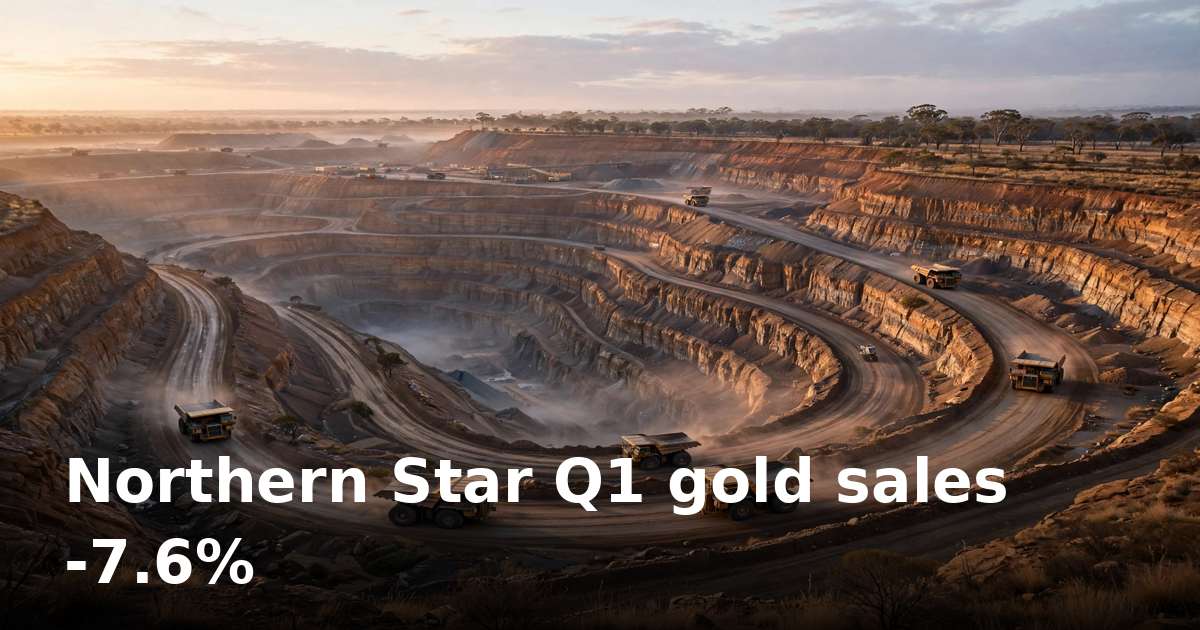

Northern Star Resources (ASX: NST) moved 363,891 ounces of gold in its fiscal first quarter, the September quarter, 7.6% fewer than the 394,000 ounces shifted in the year-ago period. The October 21 result landed while the Australian miner was in the middle of the most disruptive stretch of its KCGM mill expansion — the old Fimiston plant went dark on September 21 and the expanded replacement was only tied in on September 28. All-in sustaining costs printed at A$3,217 an ounce, squarely inside the company's A$3,050–3,450 guidance band. Net mine cash flow came in at A$210 million, with all three production centres cash-positive, though at group level underlying free cash flow printed at minus A$31 million, as the quarter absorbed a corporate tax bill of A$113 million. On the ASX, the shares finished Wednesday 1.79% higher at A$25.06.
The headline fall masks a beat. Argonaut told clients quarterly sales ran 8% above its own expectations and 7% above Visible Alpha consensus, while costs beat forecasts by 17% and 8% respectively — the market had priced in a rougher commissioning quarter.
Why it matters
This quarter is the trough the company warned about. The KCGM expansion — a new 27-million-tonne-per-annum processing plant — is the engine behind Northern Star's growth, and the changeover quarter was always going to be messy: one mill shut, another only just tied in, with commissioning still in its early stages. Management said the expanded operations were performing as expected with no "fatal flaws" found so far, and forecast KCGM to contribute 550,000 to 650,000 ounces across FY27. Against a spot gold price near $4,122 an ounce this week, the economics still work: the miner's reported average realized price of roughly A$4,999 an ounce against A$3,217 all-in costs leaves about A$1,782 of margin per ounce, a 36% cushion that buys time while the ramp plays out. For context on the broader gold tape, see our gold price analysis for October 21 and yesterday's XAUUSD key levels.
There is also a corporate angle hanging over the stock. The update follows the uninvited takeover approach from Gold Fields that valued the miner at nearly $39 billion and was rejected as undervaluing the business — Argonaut flagged that the spectre of an improved offer is likely supporting the share price. NST now trades partly on bid speculation as well as on ounces.
What to watch
- The KCGM ramp through the December quarter: whether the new 27Mtpa plant lifts throughput as commissioning beds in.
- Pogo's recovery: the Alaskan operation's ore bin and main haulage infrastructure are expected back in late October after a plant shutdown disrupted the September quarter.
- Cost drift at Yandal: its A$3,687 an ounce AISC sits above the top of the group guidance band, with higher sustaining capital offsetting better Thunderbox grades.
- The December-quarter update in January, which has to show the second-half weighting the guidance assumes.
- Any development on the Gold Fields bid front.
Key points
| Production centre | Q1 FY27 gold sold | Share of total | AISC |
|---|---|---|---|
| Kalgoorlie | 193,540 oz | 53.2% | — |
| Yandal | 117,631 oz | 32.3% | A$3,687/oz |
| Pogo (Alaska) | 52,720 oz | 14.5% | US$2,307/oz |
| Group total | 363,891 oz | 100% | A$3,217/oz (US$2,244) |
- Gold sales of 363,891 oz, down 7.6% from 394,000 oz in Q1 FY26; costs of A$3,217/oz inside the guided A$3,050–3,450 band.
- FY27 guidance held: 1.5–1.65 million ounces sold at AISC of A$3,050–3,450/oz, with output weighted to the second half.
- Net mine cash flow of A$210 million; cash and bullion of A$1.2 billion at quarter-end before a A$500 million facility draw on October 9 ahead of the final FY26 dividend.
- AISC is up sharply year on year — the September 2025 quarter printed A$2,522/oz — reflecting the capital-intensive KCGM changeover.
- Shares closed Wednesday up 1.79% at A$25.06, with analysts noting the result beat consensus on both volumes and costs.
MarketRadar take
The math shows how much depends on the second half. Annualizing the September quarter gives roughly 1.46 million ounces — below the low end of the 1.5–1.65 million ounce guidance. To hit even the bottom of the range, Northern Star needs about 379,000 ounces a quarter from here; the midpoint demands closer to 404,000. That is a real step-up from the 364,000 just delivered, so the "production weighted to the second half" line in the guidance is doing real work, not decoration. The offset is margin: at ~A$1,782 an ounce of realized spread over all-in costs, the company can afford a slow ramp — it cannot afford a stalled one. Yandal's A$3,687 cost and Pogo's late-October restart are the two lines to watch in the January update.