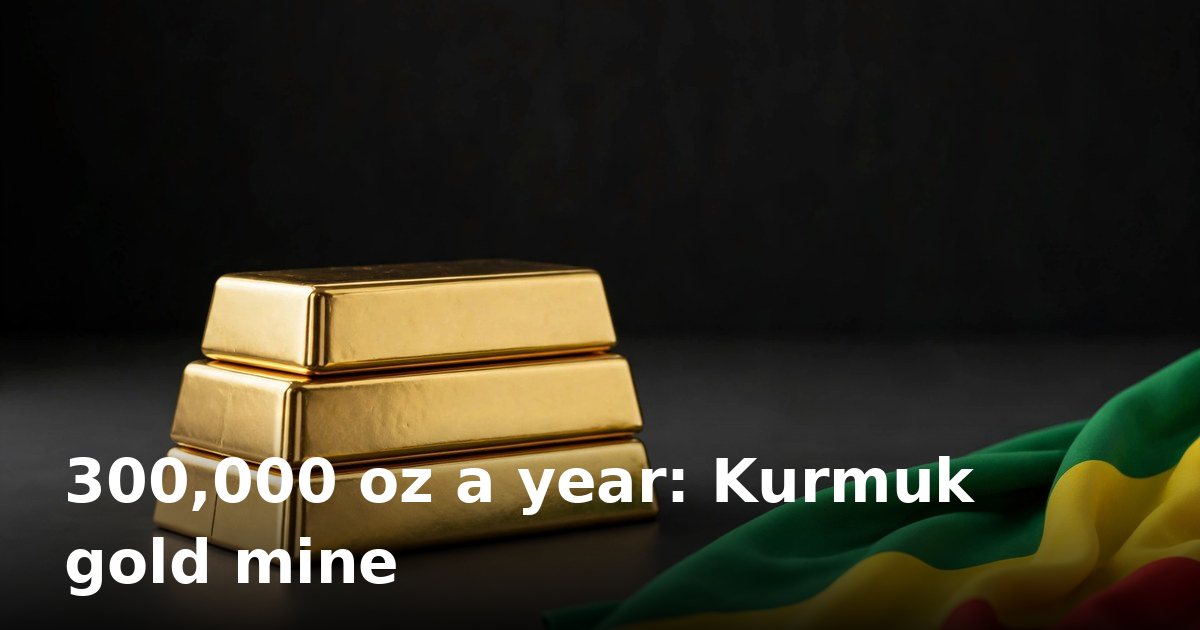

Allied Gold's newest mine is about to start doing the heavy lifting. Kurmuk, in western Ethiopia, connected to the national power grid and crushed its first ore in September, with a first gold pour described as imminent. The guidance attached to it is large enough to change the shape of the whole company: 240,000 to 270,000 ounces in 2027 and roughly 300,000 ounces in 2028. The story landed on October 25 in a Motley Fool outlook carried by Nasdaq, with gold itself just under $4,000 an ounce in MarketRadar's live snapshot, at $3,996.90.
The company's shares closed at $27.62 on October 23, up 13% over the past year, per the Fool article.
That article scores the stock 71 out of 100 in its Hidden Gems system, an Above Average band covering roughly the top 29% of scored companies. Those are the author's ratings, not MarketRadar's. The harder company numbers alongside them: revenue of $1.3 billion in 2025, up 82% year over year, with $514 million of operating cash flow and a record fourth quarter of 117,004 ounces.
How the story got here
Kurmuk is the end of a two-year build that ran in parallel with a corporate drama that, at one point, looked like it would end the company's independence altogether. In January, Zijin Gold agreed to buy Allied Gold outright for C$44 per share in cash, per the Fool article. By July, that agreement was dead, terminated after closing conditions stalled. Zijin did not walk away entirely: it instead invested roughly $295 million for a 9.2% stake.
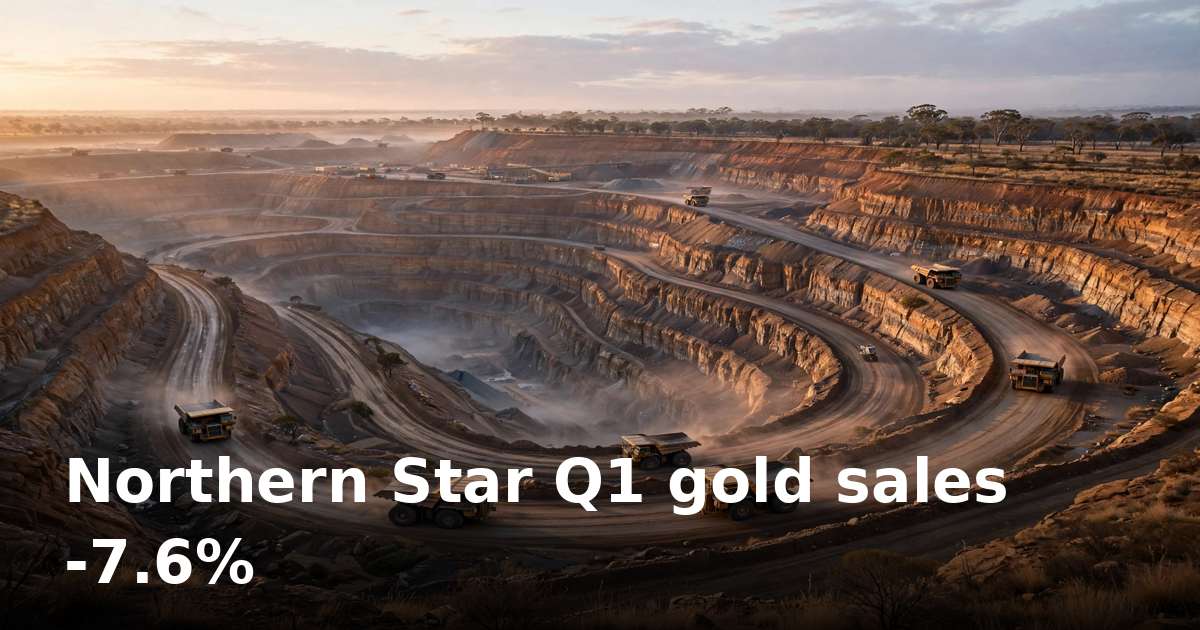
While that deal was collapsing and then being reworked, construction in Ethiopia kept moving. The company's September release, carried by GlobeNewswire, records the two milestones that matter most for a mine nearing production: the power line energised and first ore fed to the crushing circuit. Kurmuk is a conventional truck-and-shovel open pit starting from two pits, Dish Mountain and Ashashire, feeding a conventional carbon-in-leach plant on low-cost grid power. That grid connection is a genuine cost edge where remote mines often burn fuel to keep the lights on.
The base the new mine layers onto is already producing. Allied Gold runs four assets across Mali, Ethiopia and Côte d'Ivoire, and 2025 was its record year. The first quarter of 2026 then showed the other side of a capital-heavy growth story: a $58 million net loss that the Fool article attributes to accounting factors such as tax timing, even as operating cash flow stayed strong. Kalkine puts cash at about $192 million at the end of June, dented by Kurmuk construction spending and tax payments, with the Zijin placement set to top it back up. October added a drilling update, nearly 14 metres at over 10 grams per tonne, which the Fool article says suggests the 15-year life could stretch further.
Why it matters
For gold watchers, Kurmuk is a test case for a familiar tension. New supply is supposed to be the cure for high prices. Yet new mines take years to build, cost more than planned, and often start slower than guided. A single mine adding roughly 300,000 ounces a year is material in a market where most new projects are a fraction of that size. If Kurmuk hits its numbers, Allied Gold's production base grows by a step-change rather than an increment, and its cost profile improves because the new ounces are guided at costs well below the $2,192 per ounce reported for the second quarter of 2026, per the Fool article.
The risks run the other way and they are not small.
Kalkine's profile flags the obvious ones. Commissioning a new plant rarely goes perfectly. Mali and Ethiopia both carry political, security and fiscal uncertainty that does not disappear because a power line is switched on. The $2,192 second-quarter cost figure also cuts both ways. At gold near $4,000, it leaves a wide margin. In any sharp gold pullback, that same cost base would squeeze much faster than a lower-cost producer's would. The wider tape shows the contrast: Brent crude hit a five-month high while gold sank on yen speculation in recent sessions.
| Kurmuk ramp | Figure |
|---|---|
| First ore crushed / first pour | September 2026 / expected imminently |
| 2027 guidance | 240,000-270,000 oz |
| 2028 guidance | About 300,000 oz |
| First four years average | About 290,000 oz a year |
| Target mine life | 15 years |
| Reserves, Kurmuk / group | 2.7 million oz / 11 million oz |
| Exploration package | 1,450 sq km |
MarketRadar math: what 300,000 ounces means at $3,996.90
The table below is MarketRadar's own arithmetic, not company guidance. It multiplies guided ounce counts by the live snapshot gold price of $3,996.90 an ounce, recorded at 15:39 UTC on October 25, using the group's second-quarter cost of $2,192 an ounce as a stand-in, because Kurmuk has not yet published a mine-specific cost figure. Treat every row as an illustration, not a forecast.
| Scenario | Ounces | Gross value at $3,996.90 | Margin at $2,192 cost |
|---|---|---|---|
| 2027 midpoint | 255,000 | $1.02 billion | $460 million |
| 2028 guidance | 300,000 | $1.20 billion | $541 million |
| Four-year average | 290,000 | $1.16 billion | $523 million |
Two comparisons sharpen the picture. The step from the 2027 midpoint of 255,000 ounces to 300,000 ounces in 2028 is 45,000 ounces, or 17.6%, in a single year, the kind of jump that only happens when a new plant is still ramping rather than running flat out. The reserve arithmetic deserves a second look too. Kurmuk's 2.7 million ounces divided by the 290,000-ounce four-year average covers about 9.3 years, well short of the 15-year target life, so closing that gap depends on converting exploration ground across the 1,450 sq km package into new reserves.
What to watch
- The first gold pour at Kurmuk, and whether it is confirmed on schedule after September's first ore.
- Any update to 2026 guidance once Kurmuk contributes ounces; Kalkine puts existing-mine guidance at 385,000 to 425,000 ounces plus 100,000 to 150,000 from Kurmuk in its partial first year.
- Quarterly costs as Kurmuk ounces enter the mix, against the $2,192 second-quarter group figure.
- Further drilling at Dish Mountain and Ashashire, and whether it extends reserves toward the 15-year target.
- The gold price: the math above moves by about $30 million for every $100 move in gold on 300,000 ounces.
MarketRadar take
Kurmuk looks like the rare growth project that is big enough to matter and timed well enough to pay for itself quickly, if it ramps as guided.
The ounces are large, the grid power is a real cost edge, and gold near $4,000 gives the project a cushion that a $2,000 gold price never would. But the case rests on execution in its first two quarters of production, not on the reserve statement. A clean ramp to the 240,000 to 270,000-ounce 2027 range would validate the build and the Zijin stake alike. A slow ramp would leave the company carrying a $2,192 group cost base and shares at $27.62 after a 13% rise over the past year. For now, the numbers to watch are the pour date, the first quarterly cost print with Kurmuk ounces in it, and the next reserve update.