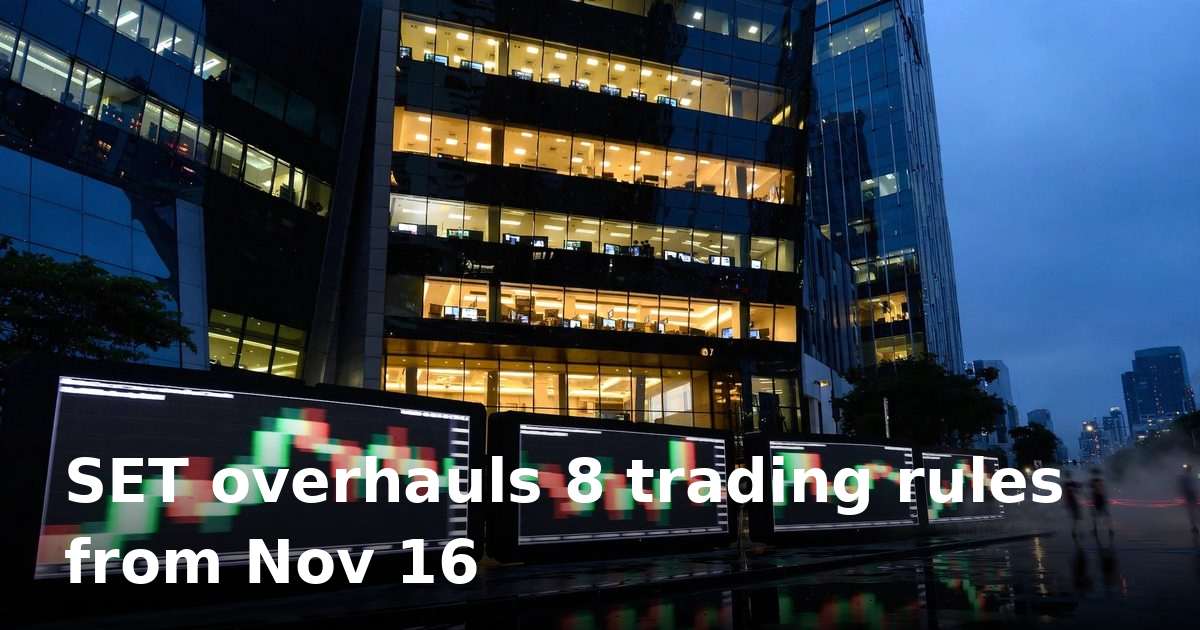

Thailand's main bourse will put a new trading rulebook into force on November 16, 2026. The eight-measure package, unveiled by SET chief Asadej Kongsiri after a May consultation with investors and brokers and sign-off by the securities regulator's board, tightens controls on short selling, moves high-frequency traders onto behavior-based supervision, and cuts trading costs with smaller price increments. The changes aim for steadier markets, deeper liquidity and stronger investor trust in a market that has spent two years rebuilding its reputation.
Short sellers are the ones who will feel this most. Every new trigger in this package lands on them first, and the midcap shield changes their hunting ground.
Under normal conditions, shorts keep the Zero-Plus Tick rule — every sell must print at the last traded price or higher. The real bite is a new trigger for bad days: if a stock closes 10% or more below its prior close, the full uptick rule kicks in for the next trading session, forcing every short sale strictly above the last traded price. Shorting also gets fenced into highly liquid names only — the SET100 blue chips, stocks with listed single-stock futures, depositary receipts and ETFs. Midcaps and smallcaps, where thin order books made them easy targets for aggressive shorts, finally get a wall of protection around them.
The high-speed crowd gets supervision instead of blanket bans. Accounts whose orders outnumber their trades 50 to 1 while averaging more than 50 orders a minute will pay 0.15 baht for each order — but only on orders beyond 15,000 a day, a line drawn high enough that genuine market makers never cross it. Registration of algorithmic flow will key off direct API connections or the footprint of machine-speed trading itself: quote pace and speed, how large positions sit at the close, how much value changes hands daily. Two friction points disappear completely. The Dynamic Price Band and the Minimum Resting Time are both scrapped, and the old limits on which securities HFT desks may trade get lifted so every investor group faces the same rulebook.
The cheapest win goes to ordinary investors. Tighter spreads on 5–50 baht shares put real money back in retail pockets on every round trip.
Shares priced between 5 and 50 baht (roughly 15 US cents to $1.50) will trade in finer price increments, a direct attack on wide bid-ask spreads in the retail-heavy middle of the market. A narrower spread is a pay rise for every small trader who round-trips those names. The same filing confirmed that day-session trading in global products — DRs, derivative warrants and ETFs tied to overseas securities — opens at 8:00am Thai time instead of 10:00am, with closing times unchanged, giving Thai investors two extra hours of access to offshore assets during the Asian morning.
The 8 measures at a glance
| # | Measure | Detail |
|---|---|---|
| 1 | Smaller tick sizes | 5–50 baht shares trade in finer increments — tighter spreads, lower costs |
| 2 | Uptick trigger | ≥10% down day → full uptick rule next session (shorts only above last trade) |
| 3 | Short-sale eligibility | SET100 blue chips, futures underlyings, DRs and ETFs only |
| 4 | Algo registration | Direct API flow or machine-speed footprints: quote pace, closing positions, daily value |
| 5 | OTR fee | 50:1 ratio + 50+ orders/min → 0.15 baht per order past 15,000/day |
| 6 | Dynamic Price Band | Scrapped — removes barriers on low-liquidity names |
| 7 | HFT tradable list | Limits lifted — identical supervision for every investor group |
| 8 | Minimum Resting Time | Scrapped — better order management, lighter member-system load |
All eight take effect November 16, 2026, alongside the 8:00am start for global products.
Why it matters
This is the final act of a two-year confidence campaign. Thailand spent 2024 and 2025 as one of the region's weakest equity markets, hit by foreign outflows, corporate fraud cases and complaints that program trading was whipping around thin names. The regulator's answer has been methodical — consultation in May, the SEC board's approval, then implementation. The SET index closed October 9 at 1,577.65, up 0.45%, and Thai shares have recently climbed to their highest level since December. A cleaner rulebook arriving while the index is recovering is what foreign funds look for when deciding whether to come back. Thailand is opening new asset doors in parallel — Bitcoin and ether ETFs get Thai approval on October 16 — so the exchange is modernizing equities and crypto listings at the same time. For broader regional context, see how Asian markets traded this week and our stocks coverage.
What to watch
- November 16 rollout: brokers must have algo-account tagging, OTR metering and the new tick tables live — watch for teething problems in the first week of trading.
- Whether the 10% uptick trigger actually slows single-day crashes in midcaps, or just shifts the selling into the following session.
- Foreign flows: the SET's own measure of success is money coming back; track weekly foreign net-buy figures through December.
- The Cabinet-backed expansion of SEC powers (approved August 25, 2026) running in parallel — enforcement headlines could move faster than the rulebook.
MarketRadar take
Structurally positive for the SET over the next few quarters, without changing the earnings picture. The 5–50 baht tick cut is the most direct liquidity gain — that price band holds a large share of retail turnover, and tighter spreads are a measurable cost cut. The uptick trigger and short-sale eligibility limits are a volatility dampener, not a ban: they preserve hedging in the SET100 while cutting off the exact behavior that scorched midcaps in 2024-25. The OTR fee is calibrated smartly — 15,000 orders a day is high enough that only genuine quote-stuffing gets taxed. Watch the 1,600 level on the SET index: a clean break with foreign inflows would confirm the market believes the reforms, not just the stimulus.