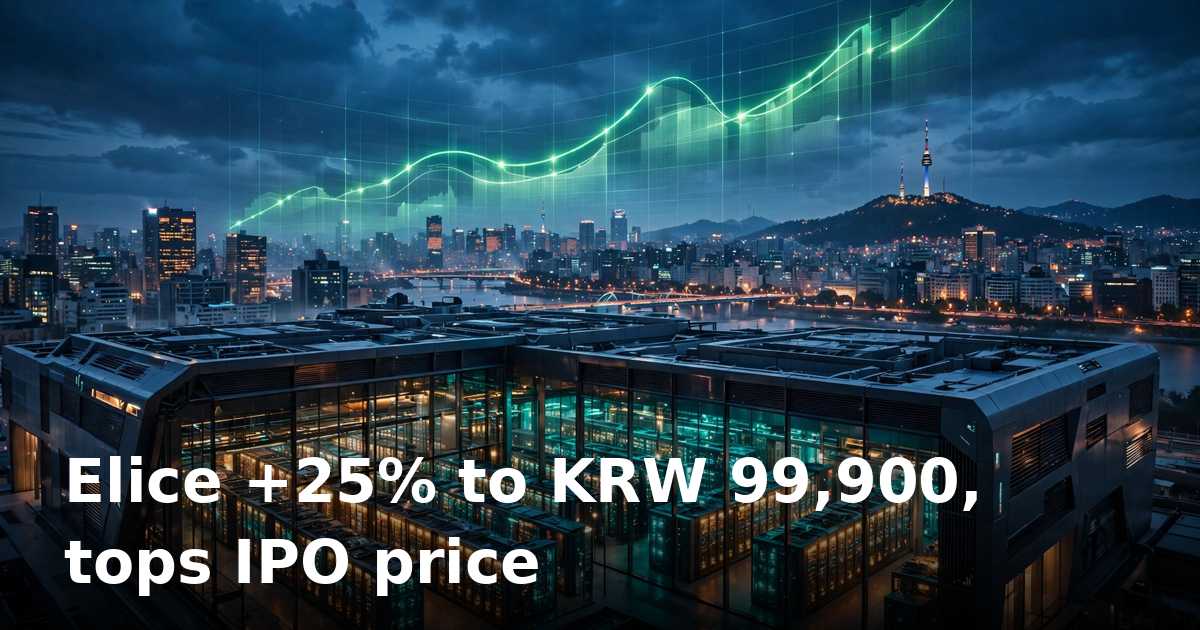

Elice shares pushed through their 90,500-won offer price for the first time on Thursday, touching an intraday high of 99,900 won on Korea's Kosdaq before easing to around 92,800 won in midday trading. The high stood 25.03% above Wednesday's 79,900-won close and 10.39% above what IPO investors paid. Roughly 6.69 million shares changed hands by midday, more than four times Wednesday's 1.60 million-share volume, with the Kosdaq session still open at the time of writing.
Three trading days, three verdicts. A 32% debut-day rout. A 30% limit-up rebound. And now a print above the IPO price.
The swings bookend an offering that looked bulletproof on paper. Elice sold 2.22 million new shares at 90,500 won apiece, the top of its 70,400–90,500 marketed range, raising 201.1 billion won — about $151 million — in the Kosdaq's biggest IPO of 2026, with a post-listing valuation north of 1 trillion won. Korean retail investors flooded the subscription with roughly 10.26 trillion won in deposits, oversubscribing their tranche 408 times, while institutions bid 388.8 times their allocation. Then Tuesday's debut shredded the script: the stock opened 16.3% low at 75,700 won, sank to 56,500 won intraday, and closed at 61,500 won — down 32.04% from the offer, the worst debut on record for a Korean IPO raising over $100 million, according to Dealogic data cited in Korean press. First-day volume of about 5.9 million shares exceeded the entire offering 2.5 times over.
| Session | Open | High | Low | Close | vs offer |
|---|---|---|---|---|---|
| Oct 20 (debut) | 75,700 | — | 56,500 | 61,500 | -32.04% |
| Oct 21 | 69,500 | 79,900 | 69,400 | 79,900 | -11.71% |
| Oct 22 (intraday)* | 77,000 | 99,900 | 75,200 | ~92,800 | +10.39% at high |
Mid-session reading; Kosdaq closes at 15:30 KST.
Why it matters
Elice has become the live test case for the global AI infrastructure debate. Its debut-day collapse was read by international media as proof that public markets are done taking AI data-centre bets on faith — the same week Firmus Grid scrapped what would have been Australia's largest IPO in 30 years (a planned $5 billion raise), Blackstone-backed AirTrunk delayed a REIT listing, Microsoft walked away from an Nscale data-centre lease in the UK over power-supply issues, and CoreWeave — down more than 50% since its May peak — kept sliding. Albert Yong of Petra Capital Management said after the debut that sentiment around AI infrastructure had turned extremely volatile and detached from fundamentals — a view that now reads as the obituary of Tuesday's confidence and the epitaph of Wednesday's. Yet Elice's fundamentals look nothing like the debt-fueled neoclouds worrying the market: first-half revenue of 34.4 billion won was up 200%, operating profit hit 10.3 billion won with a 30.1% margin (up from 13.1% last year), and EBITDA of 23.2 billion won equalled 67.5% of revenue, with AI cloud contributing 26.2 billion won — 76.2% of the total. The rebound also rode a violent turn in Korean tech sentiment: the KOSPI surged as much as 5% on Wednesday, forcing the exchange to halt program buying for five minutes as Samsung and SK Hynix led a roughly $160 billion market-wide recovery on strong US tech earnings.
What to watch
- Thursday's close relative to the 90,500-won offer — an above-offer finish turns the debut-day loss into a full round trip for IPO holders.
- Whether the volume surge sustains past the first three sessions, or the move fades with the retail frenzy.
- Continued US tech earnings, which Sina Finance cited as the driver behind Thursday's tech-sentiment turn.
- The free float — only about 16% of shares were tradeable after listing, which amplified every move; Thursday's volume implies the float turned over nearly four times over.
- Second-half results, to confirm the AI-cloud business (76% of revenue) keeps growing into the valuation.
MarketRadar take
The tape flipped from capitulation to momentum in three sessions, but the move is sentiment and flow, not fundamentals — the debut-day plunge proved how fast the AI-infrastructure story can reprice when rates stay high and the Fed stays hawkish, and nothing in Thursday's rally answered the valuation questions that broke the listing. Near-term the bias leans constructive: reclaiming the offer price plus the 1 trillion won market-cap mark, on 4x Wednesday's volume, keeps the squeeze alive while the float stays thin. The risk is that the same thin float and retail-driven volume that powered the recovery can unwind just as quickly if Korean tech sentiment rolls over.