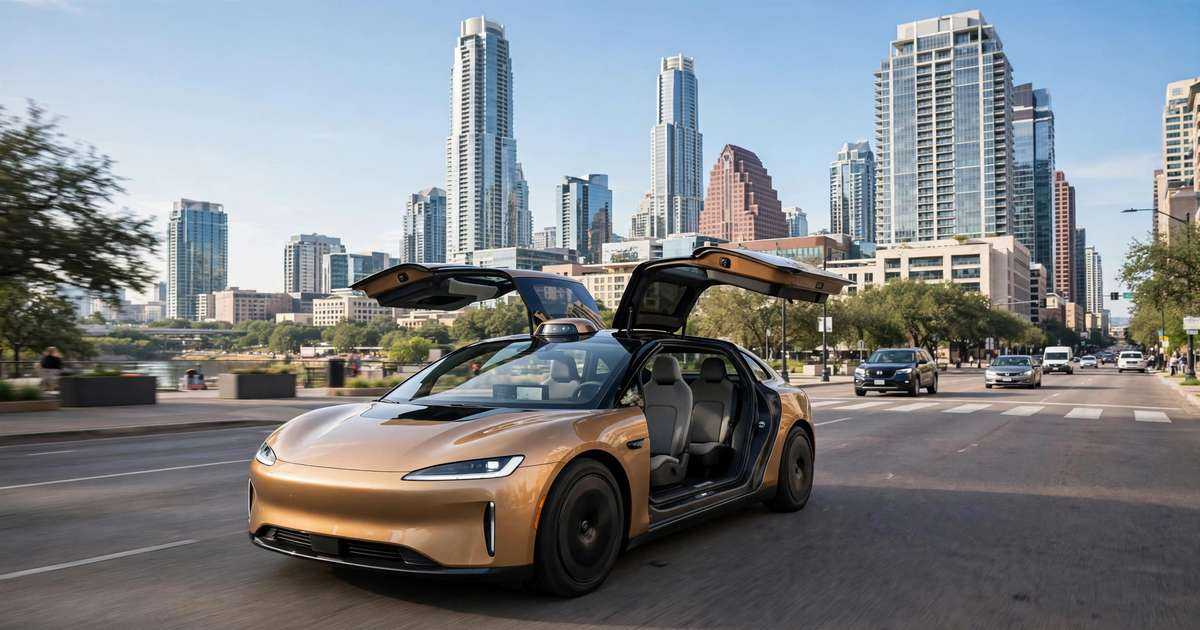

One month after Tesla's Cybercab started paid rides in Austin, the program is scaling fast and colliding with the hard limits of public trust and regulation. Texas vehicle records now clear 169 of Tesla's driverless cars for commercial service, up from 45 at the September 3 unveiling — a near-quadrupling in four weeks. The bronze two-seaters, built without a steering wheel, pedals, or mirrors, are still only running in Austin, where Tesla also fields 420 automated Model Y vehicles alongside them.
The debut month was messy. Paying riders posted complaints about 45-minute-plus waits when demand first surged, cars picking them up or dropping them off in the wrong spots, and finicky butterfly doors and trunks. The early reviews have since steadied as wait times eased — a 20-year-old Austin rider who tracks robotaxi fleets independently logged about 30 Cybercab trips and called the drive quality smooth while rating the pickup-and-drop experience as unrefined next to Waymo's more mature operation. Authorities have reported no major accidents or injuries involving Cybercabs.
Why it matters
The robotaxi business is no longer a side project for Tesla — it is the thesis investors are leaning on as the core car business shrinks. Tesla's shares are down about 18% in 2026 — the lone megacap tech name in the red this year — and vehicle revenue has fallen for consecutive years under pressure from cheaper Chinese EV makers like BYD and Xiaomi. A better-than-expected Q3 delivery report lifted the stock roughly 5% on Friday, but deliveries still fell 2% year over year. Cantor analysts wrote after that report that management expects Cybercab to eventually become the highest-volume vehicle in Tesla's lineup once production ramps — which is why month-one execution is being watched so closely.
The scale gap is the first reality check. Waymo has 1,154 autonomous vehicles cleared for commercial work in Texas alone — nearly seven times Tesla's combined Cybercab and Model Y count — and runs more than 500,000 paid rides a week across 15 U.S. markets. Read the Rivian robotaxi angle and the full stocks desk for how automakers are repricing around autonomy.
The second reality check is regulatory. The National Highway Traffic Safety Administration opened an audit query (AQ26002) into Tesla's self-certification of the Cybercab the same week it launched, questioning how a vehicle with no conventional controls meets standards written around human drivers. Tesla's deadline to answer was September 30, and the agency granted an extension. Austin's fire department separately wants rules forcing wheel-less robotaxis to give first responders a way to take control or shut down the vehicle, arguing cars should be tested for as long as they stay in service, since software updates keep changing how they behave.
The third is sentiment. A September industry survey found half of Americans would avoid a robotaxi built without a wheel or pedals, and 70% wanted Tesla to pause Cybercab rides after learning about the federal probe. California still has not permitted Tesla to operate driverless vehicles on public roads, and Musk's January prediction of robotaxis across America by year-end is nowhere near materializing.
What to watch
- Tesla's expansion into San Antonio, Dallas, Nevada and Florida — warmer states with friendlier AV rules are the stated next stops.
- The NHTSA audit query outcome: what Tesla argued in its extension request and whether the agency asks for design or certification changes.
- Any move on California driverless permits, the biggest robotaxi market in the country and one where Waymo already operates freely.
- Q4 deliveries and 2027 guidance: whether the robotaxi ramp shows up anywhere in the numbers, or stays a promise.
MarketRadar take
Run the month-one numbers and the enthusiasm cools. Adding 124 authorized cars in four weeks sounds rapid until you stack it against Waymo's 1,154 Texas vehicles and half a million weekly paid rides — Tesla is at roughly 15% of Waymo's local footprint with no disclosed paid-ride volume. TSLA jumped from $354.11 on October 1 to $370.59 on October 2, a 4.6% pop on the deliveries beat, but the stock is still 18% underwater for the year.
| Metric | Tesla (Cybercab) | Waymo |
|---|---|---|
| Texas driverless cars cleared | 169 (+420 Model Ys) | 1,154 |
| U.S. markets operating | 1 (Austin) | 15 |
| Weekly paid rides | Not disclosed | 500,000+ |
| Lifetime autonomous miles | Not disclosed | 270 million |
The honest read: the fleet ramp is real progress, and Cantor's "largest volume vehicle" thesis has a long runway. But with a federal probe open, California closed, public sentiment negative, and the volume leader operating at 7x scale, the Cybercab story faces execution risk that Friday's 5% bounce did not price in. Direction stays cautiously negative until expansion actually lands outside Austin.