Crude kept moving out of the Strait of Hormuz in October at nearly 11.1 million barrels a day, only about 2% below September, even as 30 or more vessels — chiefly oil tankers — came under attack by October 27, with 16 or more crew hurt (International Maritime Organization). September had recorded 15.
The market priced the risk, not a shutdown.
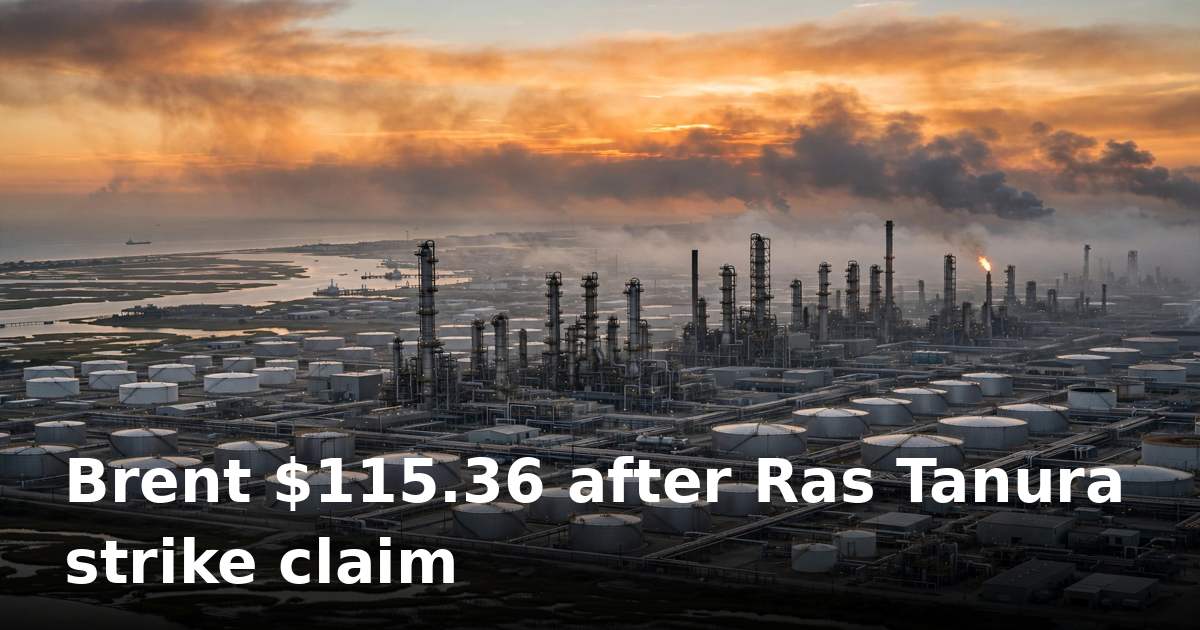
Brent's December contract, which expired on Friday, traded above $117 a barrel and touched $118 intraday, just under the $118.35 wartime closing peak set during March's attack wave. Reuters put the December contract at $117.75, up 2.5%, with WTI at $104.79, up 2.7%. Both benchmarks headed for a fourth straight monthly gain: Brent about 13% higher in October, WTI about 15%.
Background: from the March collapse to the October shuttle
War between the United States and Israel and Iran began on February 28, and Tehran hit commercial shipping in the strait within a day. The first wave worked: crude exports through Hormuz fell close to 90%, to 1.8 million barrels a day in March from 16 million in February, per Kpler. Flows rebuilt over eight months under United States protection through a shuttle system: tankers load at Gulf ports, cross Hormuz with transponders off, and pass cargo to ships anchored in the Gulf of Oman for Asian refiners. Kpler data cited by CNBC shows flows through the strait up more than 70% since July.
The strait carried huge volumes before the war. Energy Information Administration data puts average Hormuz transit at 20.9 million barrels a day across the first half of 2025, about a fifth of the world's petroleum-liquids use at the time, with Asia taking 89% of its crude and condensate flows. The closing week of October dropped to 7.3 million barrels a day, over 40% under the pre-war baseline, per Kpler.
The week that pushed Brent to $117
Late on Thursday, the United Kingdom Maritime Trade Operations agency said a small craft came alongside a tanker roughly 25 nautical miles off Khasab, Oman, at 22:12 UTC and fixed two explosive devices above the waterline on the hull. The blasts set the engine room on fire and left the ship unable to move. UKMTO later said the blaze was extinguished, everyone aboard was unhurt, the sea was unaffected, and the ship resumed its voyage. Reuters, citing maritime sources, described the attack as the first limpet-mine success in the waterway since February, when the war began.
Tehran gave a different account. Its Revolutionary Guard said three tankers using routes it calls unauthorised were halted, one a supertanker carrying more than 2 million barrels that exploded and caught fire. On Friday, Oman's Maritime Security Centre said its navy rescued 25 crew from the burning Panama-flagged crude tanker RITI in the strait. United States Central Command chief Adm. Brad Cooper said the primary transit routes had been cleared of Iranian sea mines, a claim the Guard rejected. On Thursday, Yemen's Houthi movement said it had attacked Saudi sites including the Ras Tanura and Rabigh refineries and an Aramco facility at Abqaiq. A Saudi-led coalition said it intercepted a cruise missile. In Libya, the National Oil Corporation said a militant group closed a valve on the main Hamada pipeline on Friday, stopping roughly 15,000 barrels a day headed for the Zawiya refinery.
MarketRadar data: flows, prices and the freight bill
| Hormuz crude flows, Kpler data via CNBC | Million barrels a day |
|---|---|
| February 2026, pre-war month | 16.0 |
| March 2026, first attack wave | 1.8 |
| September 2026, MarketRadar calculation from the 2% gap | 11.3 |
| October 2026 average | 11.1 |
| Closing week of October | 7.3 |
| Friday prices, Reuters unless noted | Level | Day move |
|---|---|---|
| Brent, December contract expiring Friday | $117.75 | +2.5% |
| WTI | $104.79 | +2.7% |
| WTI, MarketRadar snapshot at 19:39 UTC | $104.30 | +2.23% |
The freight math shows why flows held up. Chartering a large crude carrier out of the Gulf of Oman toward Asia ran $249,000 a day in early September and topped $900,000 a day in early October, a 3.6-fold rise. Transport per barrel went from $6.50 in September to about $21 now, a 3.2-fold rise, with roughly a fifth of all supertankers on this shuttle work. MarketRadar's calculation: 11.1 million barrels a day at $21 a barrel is about $233 million a day in transport, against about $73 million a day in September — roughly $160 million a day of added transport cost. CNBC reports freight eats up between a fifth and almost a third of what an Asian importer pays per delivered barrel.
Why it matters
Asia absorbs most of this oil, so a longer or wider disruption lands first on Asian refiners, whose margins carry that freight load. Gulf producers now cover shipping cost and risk themselves, putting more of their own tankers on the route to hold Asian market share against United States and Atlantic suppliers, per CNBC. Shipping executives told CNBC few owners would take the risk without United States air cover, and one Braemar analyst summed up the month by saying the net effect on oil volumes coming out was limited.
What to watch
- The November 3 United States midterms, and the reported message to Gulf states about a short, intense campaign after the vote (Wall Street Journal).
- Qatari mediators, back in Tehran on Friday per Reuters, and any deal that would cut the shipping-risk premium.
- Whether the shuttle holds October's 11.1 million pace or slips toward the closing week's 7.3 million.
- Brent's $118.35 wartime closing high as the next marker; Saxo sees $70 to $90 after the conflict ends, against $60 to $70 before it.
Key points
- Hormuz crude flows averaged nearly 11.1 million barrels a day in October, about 2% below September, despite 30 or more vessels attacked by October 27 (Kpler via CNBC; IMO).
- Brent's December contract hit $117.75, near the $118.35 wartime closing high, with Brent up about 13% and WTI about 15% in October (Reuters).
- A limpet-mine strike on a tanker off Khasab, Oman, was the first strike of its kind known to succeed since the war began in February (UKMTO via Reuters).
- Oman rescued 25 crew from the tanker RITI; Iran said three tankers on unauthorised routes were halted, one a supertanker over 2 million barrels (Al Jazeera).
- Freight runs about $21 a barrel against $6.50 in September, adding roughly $160 million a day in transport cost at October flow rates (MarketRadar calculation).
MarketRadar take
The near-term tilt for crude stays up while attacks continue and flows sit below the pre-war baseline. Brent at $117.75 leaves the $118.35 March closing high as the line to watch: a break above it on another incident would confirm the market pricing a wider disruption. The counterweight is diplomacy and politics: Qatari mediation, and whatever follows the November 3 vote, could unwind the premium, since the same freight math that lifts prices now reverses when normal transit returns.