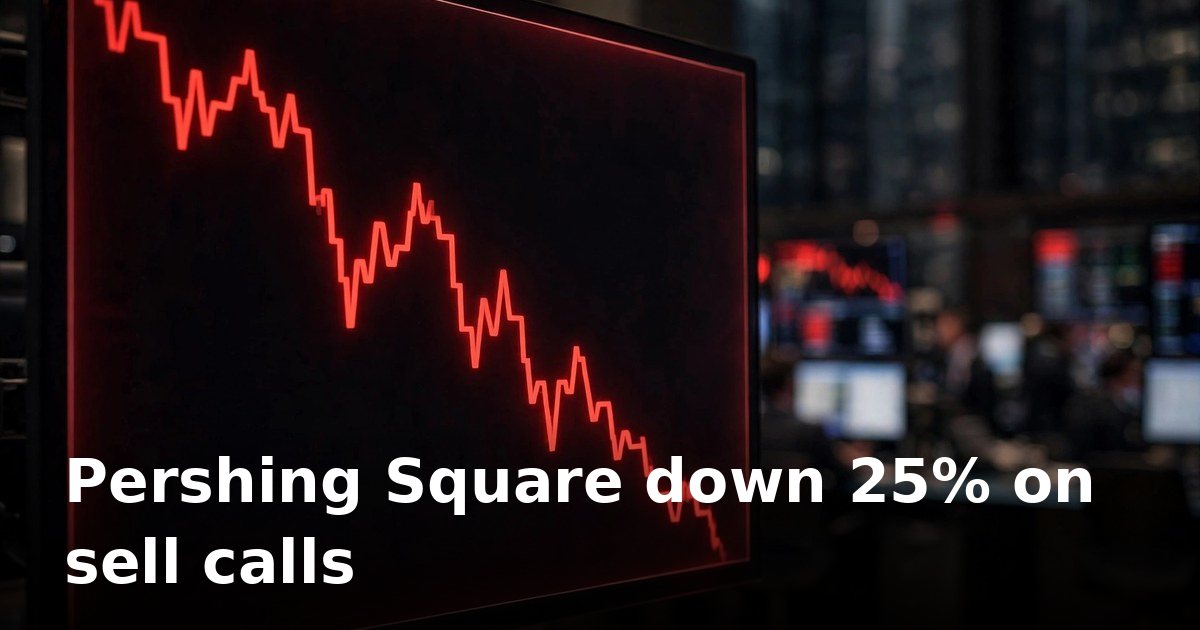

Bill Ackman's Pershing Square (NYSE: PS) has lost roughly a quarter of its value in a single week. The shares touched $60 on October 7 — 150% above the $24 IPO price set on April 29 — then slid to about $44.48, down 4.7% on the session when the latest downgrade coverage landed. Two Wall Street desks drove the reversal: Citi cut the stock to sell while holding a $45 price target, and Bank of America downgraded it to underperform with a $38 target, down from $54. Both firms pointed at the same problem — a valuation that sprinted far ahead of the earnings underneath it. Citi put a number on the excess: 54 times forward earnings.
Citi's note, published October 9 by analyst Matthew Heimermann, kept the $45 target but trimmed 2027 earnings estimates to $0.89 a share from $1.01. The firm tied the cut to tepid investment performance across its fund lineup, led by the two biggest vehicles — Pershing Square Holdings on the one hand, Pershing Square USA on the other. Even after the trim, $0.89 would mark a 74.5% jump over the $0.51 in adjusted 2026 earnings analysts expect — growth the current price already assumes in full. Heimermann was blunt about the gap, writing that the shares' near-term valuation "cannot be rationalized" — profit forecasts have barely moved since the April listing, which he read as a sign of underwhelming portfolio gains.
Bank of America's downgrade landed October 13 and hit harder on the tape. The stock fell 11.62% by 12:45 p.m. ET that day and finished the Tuesday session down 7.5% at $50.15 after trading as low as $49.42. BofA's case runs through the business model itself: most of Pershing Square's income comes from fees charged on managed assets, so when assets shrink, the fees shrink with them. The bank also flagged the fund record: the flagship Pershing Square Holdings vehicle has dropped 8% so far in 2026 while the S&P 500 has climbed 15%, and it opened the year with a 16% first-quarter loss. Its biggest positions include Uber and Brookfield alongside Microsoft, Amazon and Meta. Its $38 target implies roughly 15% downside from current levels over the next 12 months.
The business did not change in a week. The price did — and the price is what both desks are now selling against.
The background: from a $24 IPO to $60 in five months
Pershing Square listed on April 29 in a combined offering alongside its Pershing Square USA fund, opening at $24 a share. Listed asset managers are valued on fee streams rather than fund returns, and Ackman's firm arrived with a celebrity premium attached: permanent capital, a famous stock-picker, and a compounding story. Investors paid up. The stock climbed roughly 87% from the IPO and peaked at $60 on October 7, a 150% gain at the top tick.
Underneath, the funds told a quieter story. Second-quarter revenue came in at $54.18 million against expectations of $77.32 million — a miss of nearly 30%. Both listed funds change hands below the value of their holdings — Pershing Square Holdings sits 36% under its net asset value and Pershing Square USA 23% under — the market's own verdict on the portfolio. Even Citi's bearish note conceded the structural bull case: permanent capital, Heimermann wrote, deserves a richer multiple than an ordinary manager gets — he called it greater duration value. His objection was timing rather than structure: in his view, earnings still have to grow into a share price that sprinted ahead of them.
Why it matters
This is a valuation story rather than a blow-up, and that distinction is why it reaches beyond one ticker. A listed manager's multiple rests on two pillars — fee durability and fund performance — and both wobbled at once: returns lagged while the multiple expanded, and BofA's fee-sensitivity argument closes the loop, because weak performance shrinks assets, which shrinks fees, which shrinks the earnings the multiple is applied to. There is also a supply question hanging over the tape. Wells Fargo, which initiated coverage on October 1 with an underweight rating and a $41 target, cautioned that the pool of shares investors can actually buy might expand to roughly three times its current size toward the end of October. More sellers meeting fewer believers is the classic setup for multiple compression. The street has noticed: across 12 analysts the stock now carries a consensus "Reduce" rating with a $42.11 average target — about 5% below Friday's print.
What to watch
- Pershing Square Ventures: the planned private-equity fund offering pre-IPO access, due by end of 2026 and meant to diversify revenue beyond management fees — BofA tied part of its estimate cuts to a delay in this launch.
- Howard Hughes and the insurance float: Ackman used his Q2 shareholder letter to compare the Howard Hughes/Vantage combination with Berkshire Hathaway — a "modern-day" version built on insurance float; Citi named it the clearest upside catalyst if that float compounds.
- Late-October supply: whether Wells Fargo's warning about a tripling of tradeable shares materializes, and how the price absorbs it.
- Fund NAV prints: any narrowing of the 36% and 23% discounts at PSH and PSUS would undercut the bears' core argument.
MarketRadar take
The arithmetic behind Heimermann's verdict is worth spelling out. Citi's $45 target on its $0.89 2027 earnings estimate prices the stock at 50.6 times forward earnings; against the $0.51 expected for 2026, the same target is 88 times. At the $60 peak, the shares traded at roughly 67 times Citi's 2027 number. Tellingly, even the bears are paying a premium: BofA's $38 target still values Pershing Square at 42.7 times 2027 earnings — a rich multiple for any asset manager, and a quiet admission that the perpetual-capital structure deserves something above the sector average.
| Firm | Rating | Target | Detail |
|---|---|---|---|
| Citi | Sell (from Neutral) | $45 | Oct 9; flagged 54x forward earnings |
| Bank of America | Underperform (from Neutral) | $38 | Cut from $54 on Oct 13 |
| Wells Fargo | Underweight | $41 | Initiated Oct 1; flagged late-Oct supply |
| RBC | Sector Perform | $44 | Raised from $41 |
| Tigress Financial | Neutral | $41 | Raised from $39 |
| JonesTrading | Hold | — | Cut from Buy on Sep 29 |
| Consensus (12 analysts) | Reduce | $42.11 | 1 Buy / 7 Hold / 4 Sell |
The setup from here is binary around execution. If Pershing Square Holdings recovers, the Ventures fund launches on schedule, and the Howard Hughes insurance float compounds as Ackman describes, the multiple has room to stabilize near current levels. If fund returns stay tepid, the extra late-October share supply arrives on Wells Fargo's timetable, and assets drift lower, BofA's mechanism takes over: smaller asset base, smaller fees, smaller earnings, smaller multiple. With the consensus target sitting 5% below the current price and two major desks actively negative, the burden of proof has shifted squarely onto the bulls. Near term, the read is bearish — not because the franchise is broken, but because $44 still pays for perfection the funds have not delivered.