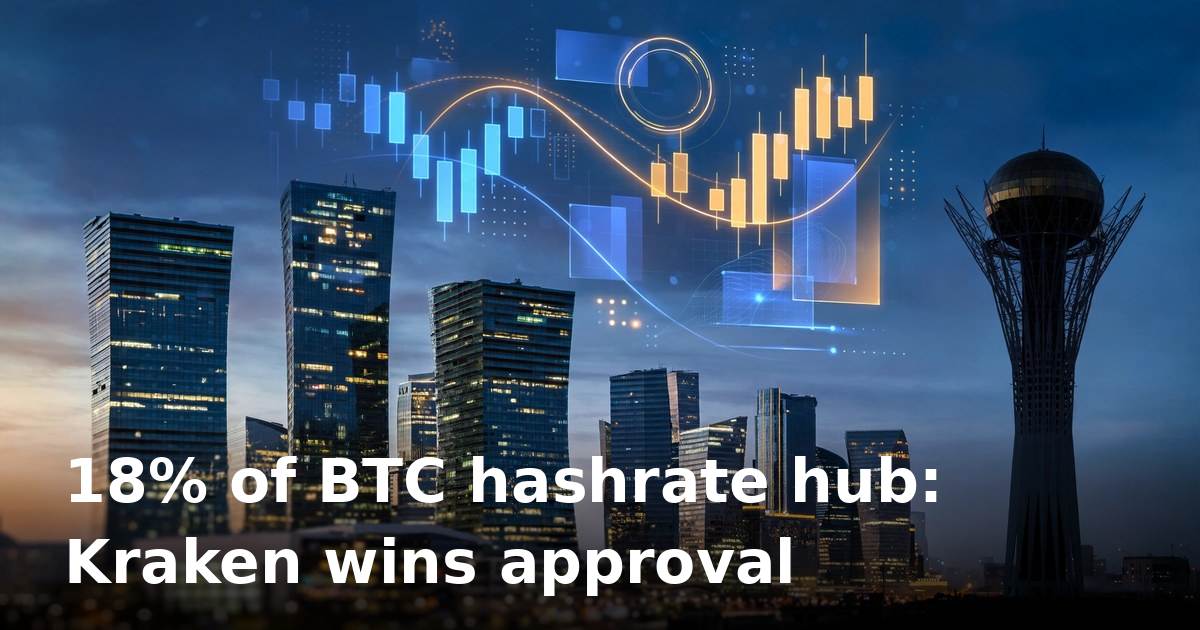
Kazakhstan is showing exactly what its new crypto rules look like in practice: the same week its court shut the door on unlicensed exchanges, the country's regulator opened one for Kraken. Payward, the parent company of the exchange, announced on Thursday that Kazakhstan's financial watchdog, AFSA, had given it a conditional green light to open a local licensed unit, Payward Kazakhstan, in the AIFC — Astana's international financial centre. The preliminary approval covers running a digital-asset trading venue, handling investments both on the firm's own book and for clients, and offering digital-asset custody.
This is not a full license — the approval is conditional, and Payward still has to clear the regulator's outstanding conditions before it can take on clients; no timetable was disclosed. Once fully cleared, traders in Kazakhstan would get direct access to Payward's global order books, tying local flow to liquidity in Europe, America and Asia. Payward co-CEO Dave Ripley praised the AFSA and AIFC teams as "constructive and rigorous" through the process.
Why it matters
The contrast with what happened 48 hours earlier is the whole story. On Tuesday, the AIFC Court barred Coinbase, BingX, Bitcoin.com, HTX, BitMart and WEEX from offering unlicensed crypto services in its jurisdiction — and ordered Google and Apple to geo-restrict their apps. Two days later, the regulator rewarded the company doing it the licensed way. Kazakhstan is building a two-tier market: authorized operators get access, unlicensed ones get ejected at the app-store level. The backdrop matters too: Kazakhstan hosted roughly 18% of global bitcoin hashrate at the 2021 peak, and that share has since collapsed to about 1.6% as miners were squeezed off the grid by fees and licensing rules. The country that once sold cheap electricity to mining farms now sells licenses to trading firms. That reversal took five years.
That makes this a working template worth watching. Few regulators have combined court enforcement and platform-level distribution control this aggressively, and the sequencing here was deliberate: warn, sue, eject, then welcome the compliant. Exchanges that treat licensing as optional are learning the cost is not a fine — it is removal from the market entirely.
License or leave. There is no third option in Astana anymore — and regulators elsewhere are watching whether this template travels.
| Date | Payward's October moves |
|---|---|
| Oct 12 | Full VARA approval secured in Dubai; UAE launch planned |
| Oct 14 | Deal to buy Saldo Bank, an EU-licensed lender |
| Oct 14 | MoU signed with Kazakh PM Olzhas Bektenov |
| Oct 20 | AIFC Court bars six unlicensed platforms, incl. Coinbase |
| Oct 22 | In-principle AFSA approval for Payward Kazakhstan |
The pattern is a coordinated regulatory sprint. In-principle approval in Kazakhstan follows a signed government MoU by eight days, and Payward has stacked Dubai, an EU banking license and now Central Asia in under three weeks. This is what exchange expansion looks like when compliance is the product strategy rather than the afterthought.
What to watch
- Whether AFSA grants the final license and how long the remaining conditions take — the press release gave no timeline.
- Whether any of the six barred platforms follow Kraken's route and apply for AFSA authorization.
- AFSA's public register of licensed firms, which will confirm Payward Kazakhstan's status as it changes.
- Whether other jurisdictions copy Kazakhstan's playbook of pairing license offers with court-ordered app-store enforcement.
MarketRadar take
Structurally supportive for licensed exchanges. Kazakhstan's approach — eject the unlicensed, authorize the compliant — widens the moat for operators willing to pay for regulation. For Kraken, the revenue from Kazakhstan itself will be modest in the near term; the real value is the precedent and the regional network it is assembling across Dubai, Europe and Central Asia. The divergence between exchanges that license and those that don't is becoming the single cleanest dividing line in crypto this year.