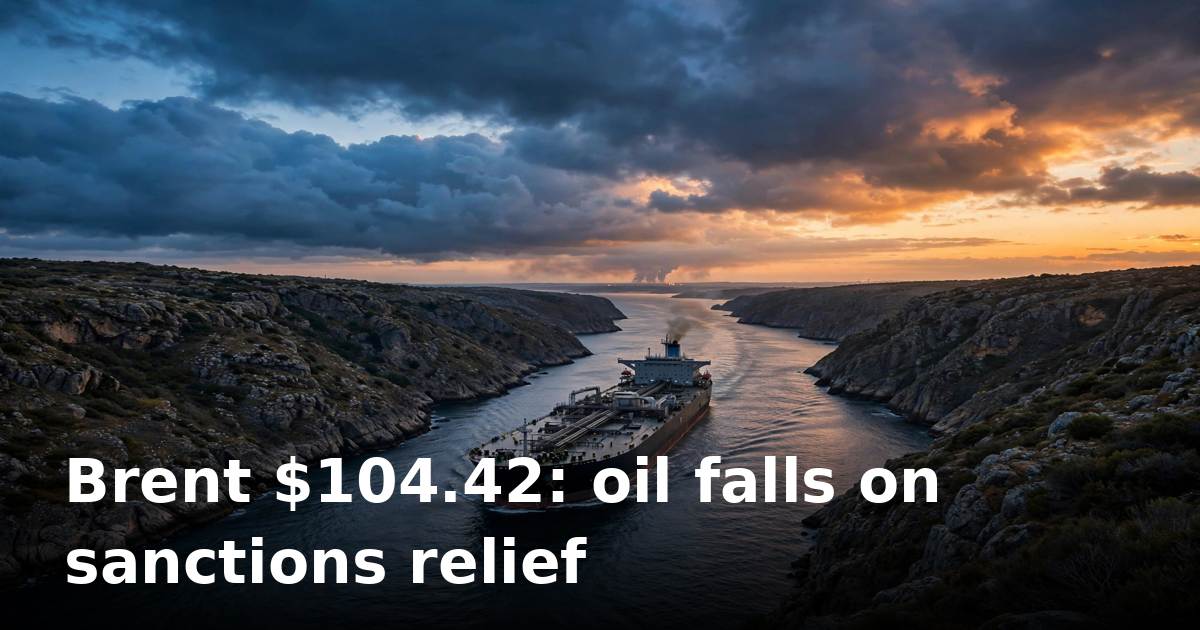

Brent crude dropped $1.64 a barrel (1.6%) to $104.42 on Thursday, while US West Texas Intermediate fell 98 cents (1%) to $94.11, Reuters reported. Both contracts handed back most of Wednesday's gains, when WTI touched a three-week high. The day's move is a tug-of-war: attacks on one of the world's busiest shipping chokepoints push prices up, while the prospect of US sanctions relief on oil tankers pulls them down. Our snapshot agrees — WTI at $94.1, down 1.02%. The Economic Times pegged Brent at $104.55, down 1.41% — same direction on every wire. Physical danger on the water, policy relief in Washington: crude's defining tension.
Wednesday's rally began with force. Houthi fighters hit the Saudi Aramco headquarters, while Tehran announced it would use fresh methods against commercial traffic in the Hormuz corridor, with the stated goal of propping up crude. Maritime officials confirmed two vessels — a container carrier and a dry bulk ship — lost to projectile fire within a day. Tehran blames the American port blockade and September's tougher sanctions round.
Washington, meanwhile, is weighing relief: loosening penalties on the unregulated "shadow fleet" of tankers that moves oil and products from Russia, Iran and Venezuela despite the restrictions. A US official said Wednesday the talks center on letting "legal oil" flow on previously sanctioned vessels. With the war driving freight costs to record highs, any transport relief would feed straight through to physical supply. The logic is blunt: record freight costs tax every barrel that gets through, so putting sanctioned hulls back to work is the administration's fastest lever to cool pump prices.
Why it matters
Crude refuses to rally on bullish news — that is the tell. The October 9 week delivered an 11.1-million-barrel US crude draw, far more than the Reuters poll expected, yet prices slipped anyway. A market that can't rise on its best inventory print is warning traders not to chase it higher.
Zoom out and the market is still tight. Brent is up $2.17 (2.1%) since closing at $102.25 on October 2; WTI is up $3.00 (3.3%) from $91.11. The IEA said Wednesday that Gulf crude exports jumped 4.4 million barrels a day in September — roughly 75% of prewar levels — while Russia lifted output 65,000 barrels a day to 8.43 million, still 870,000 below a year ago. That sits next to yesterday's IEA report of record UAE output: output is recovering, but barrels can't reach buyers cheaply while ships are under fire. Goldman's Daan Struyven warned shipping disruptions can spread and intensify — the market is discounting that for now.
The Fed is watching too: September CPI ran hot at 3.7%, gasoline's 9.1% monthly jump driving more than half of it — so crude's path feeds into the October 28 rate decision, where another hike is back on the table. More on our commodities desk.
What to watch
- EIA report today, 1600 GMT — official inventory data after the API's big 11.1-million-barrel draw; delayed a day by Columbus Day.
- Washington's shadow-fleet call — "legal oil" on previously sanctioned vessels would loosen effective supply fast.
- Hormuz shipping — another attack or sinking reprices the war premium instantly.
- Gulf export recovery — whether the return toward 75% of prewar levels holds into October.
MarketRadar take
| Level | Price | Note |
|---|---|---|
| Brent (Thu print) | $104.42 | -$1.64 (-1.6%) |
| WTI (Thu print) | $94.11 | -$0.98 (-1.0%) |
| Brent-WTI spread | $10.31 | Atlantic war premium |
| Brent since Oct 2 close | +$2.17 (+2.1%) | vs $102.25 |
| WTI since Oct 2 close | +$3.00 (+3.3%) | vs $91.11 |
Goldman Sachs' scenarios from the $104.42 Brent print: $120 on escalation (+$15.58, +14.9%) versus $80 on normalization (-$24.42, -23.4%). Near-term drift favors softer prices while shadow-fleet relief talk hangs over the market — but one more major Hormuz incident reprices everything higher, and nothing in the current setup stands in its way.