
Kristalina Georgieva picked an awkward moment to deliver a blunt message. Speaking in Singapore on Wednesday, days before finance ministers and central bank governors gather in Bangkok for the Fund and the World Bank's yearly meetings, the IMF's managing director laid out the squeeze in plain terms. Three forces are pressing on the world economy at once: the rapid arrival of artificial intelligence, stubbornly high energy prices, and record levels of public debt. How policymakers navigate those three crosscurrents, she said, will decide whether this decade's underwhelming growth rates can be bettered at all.
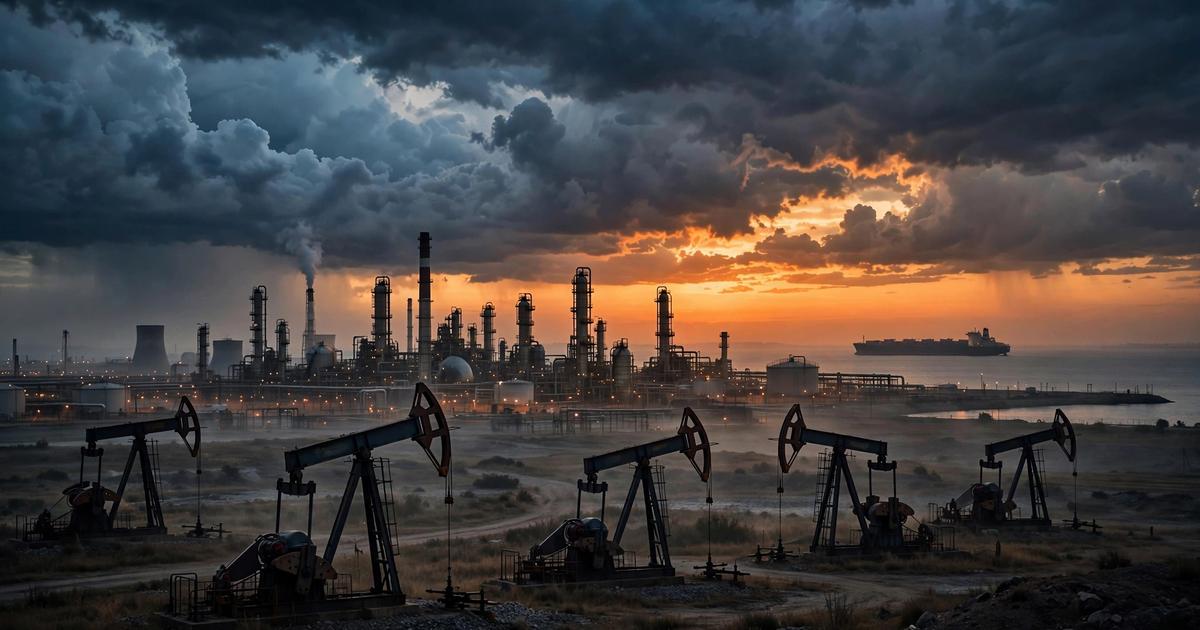
The energy leg of the warning is the one oil traders will feel first. Crude is holding around $100 a barrel — already about 12% above the $89 average the IMF pencilled in for 2026 back in July. Georgieva's message: this is not a spike that fades with a ceasefire. A quick end to the Gulf fighting, she said, would still leave high energy prices in place for some time, with Brent futures markets pricing expensive oil all the way through 2027. Brent closed at $102.25 on October 2, after dipping briefly below $100 intraday.
The refining side makes the picture worse for consumers. Damaged and impaired refining capacity is adding roughly another $100 a barrel in crack-spread margins on key products such as diesel, which means the fuel actually reaching trucks and factories is pricing like $200 crude. Retail diesel and refined-product prices are at record highs. Winter heating season is approaching, Hormuz gas shipments stay under threat, and demand is about to get a seasonal tailwind on top of a supply squeeze.
The Fund's July forecast is already coming apart at the seams. Every assumption behind it has failed. Oil, Hormuz, growth — all of them.
Why it matters
This is the IMF effectively telling markets its own July forecasts are already stale. Back in July, the Fund's numbers had global output at 3.0% for 2026 and 3.4% for 2027 — built on crude averaging $89 this year and $78 the next, with the Hormuz waterway partly reopening from mid-July and normal traffic by March 2027. None of that has happened. New projections land during the Bangkok meetings next week, and Georgieva flagged the deepest downgrades for economies hit hardest by fighting — Ukraine, plus Gulf producers whose energy shipments have collapsed after Iranian attacks. The July vintage also put 2027 crude at $78 a barrel, a number that now looks like wishful thinking with futures curves pricing tightness straight through next year and refined-product margins running at record levels.
For traders, the cross-asset signal is hawkish. US 10-year yields are at their highest since 2007. German yields are at their highest since 2009, Japanese yields since 1996 — and still climbing, per Georgieva. She described the recent round of increases from the US, European and Japanese central banks as entirely justified and said a prudently hawkish tilt may suit many countries now. That lines up with the Fed's own stance. The US central bank raised rates 25 basis points on September 16 and has shown no appetite for easing after the weak September jobs print. Bond markets feel this too. The same rising-yield pressure capping the silver rebound is now the IMF's top systemic worry. Elevated yields inflate government interest bills exactly when defense spending is competing for tight budgets.
What to watch
- IMF World Economic Outlook update during next week's Bangkok meetings — expect the 3.0% 2026 growth number to be revisited
- Brent crude around the $100 level: a sustained break higher would confirm Georgieva's "persistent" thesis; a slide back under $95 would challenge it
- Diesel crack spreads and retail fuel prices through the winter heating season, with Hormuz LNG flows still restricted
- 10-year yields in the US, Germany and Japan — fresh multi-decade highs would tighten financial conditions further
- Gulf energy export data for signs the "shaky recovery" in flows is stabilizing or deteriorating
| IMF July assumption | October reality |
|---|---|
| Oil averages $89/bbl in 2026 | Trading ~$100/bbl, about 12% above the assumption |
| Oil averages $78/bbl in 2027 | Brent futures price expensive oil through 2027 |
| Strait of Hormuz | Partly reopens from mid-July — still restricted, LNG shipping under threat |
| Global growth 3.0% in 2026, 3.4% in 2027 | New forecasts due at the Bangkok meetings |
| — | Public debt set to top 100% of GDP before 2030 |
MarketRadar take
The commodity read here is straightforward. As long as Gulf flows stay impaired and Hormuz shipping stays threatened, the $89 average the IMF modelled for 2026 looks unreachable from below. Oil is already living 12% above it, and diesel margins are doing double damage at the consumer level. The asymmetry cuts both ways, though. If the Strait reopens anywhere near the IMF's March 2027 assumption, the $78 average for next year becomes the gravitational pull. Until there is evidence of that, crude holds a fundamental bid. Gold keeps its haven bid intact too — dealers at last week's LBMA gathering were still talking $5,000-plus within a year in our gold coverage. Bonds stay under pressure from the supply-shock inflation Georgieva described. Watch the Bangkok forecasts: a formal IMF downgrade of the 3.0% growth call would be the confirmation trade for the hawkish-energy thesis.