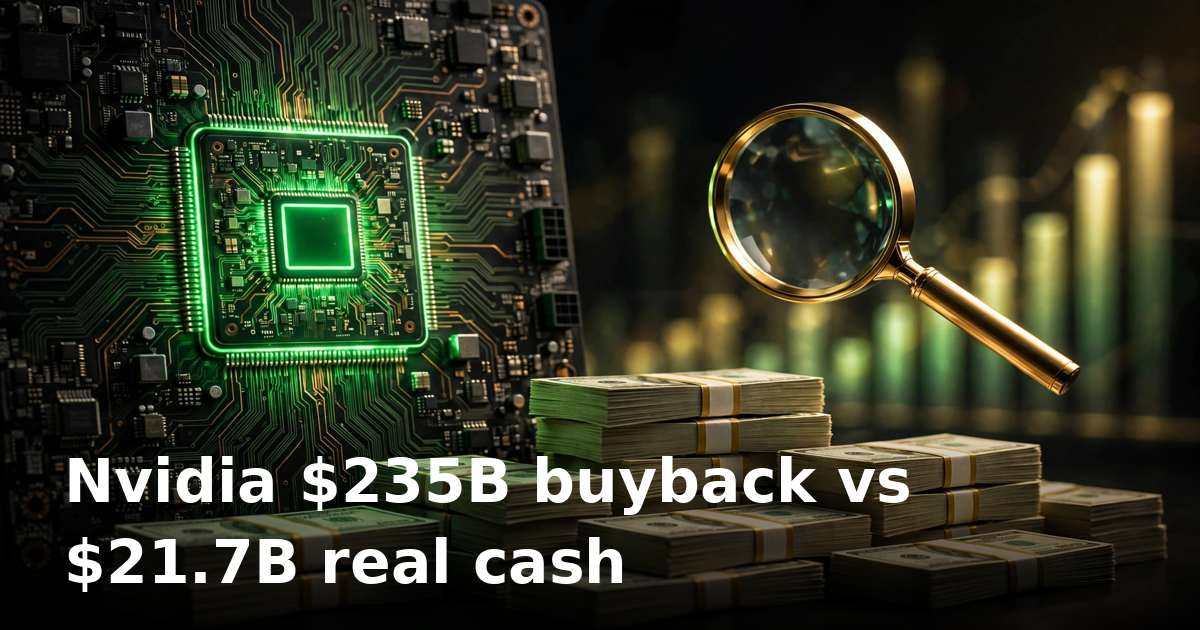

Nvidia launched the largest share buyback in US corporate history last month, lifting its repurchase authorization by $150 billion to $235 billion through fiscal 2028. Then it told investors something most people missed. In a September 28 presentation, the company said it would return excess cash through buybacks and a gradually growing dividend — but only "net of strategic uses". Those four words quietly disclosed that the cash Nvidia pours into AI startups competes directly with the cash available for shareholder returns.
The numbers behind the caveat are striking. In the six months ended July 26, Nvidia spent $42.4 billion buying equity investments and collected $7.2 billion selling them, a net outflow of $35.2 billion. Its reported free cash flow for the period was $69.9 billion. Treat those investments the way capex is treated, and the free cash flow figure falls by half, to $34.7 billion. There is more. Nvidia handed over $4.5 billion in withholding taxes as employee shares vested, and roughly $9 billion of its buybacks in the period merely offset dilution from stock awards, according to a Wall Street Journal analysis. Factor in all of it, and the period's real free cash flow drops to about $21.7 billion — less than a third of the headline number.
That is the gap. A $235 billion authorization funded from a cash stream that, fully adjusted, runs at $21.7 billion per half year.
Nvidia's portfolio now covers 13 listed companies and 229 private ones across the AI ecosystem, including OpenAI and Anthropic — cash that goes into portfolio companies helps them buy Nvidia products, a circular dynamic that has raised sustainability questions about the AI boom. Nvidia added $24.9 billion of long-term debt in the same six months, taking the total to $32.4 billion, while spending almost $31 billion on buybacks beyond what was needed just to keep its share count flat. The debt raise helps explain how discretionary buybacks were funded after strategic investments and stock-pay costs absorbed so much cash.
One change deserves credit. In its latest quarterly filing, Nvidia split debt and equity securities into separate lines within investing activities, so investors can do these adjustments themselves. Microsoft, Amazon and Alphabet still bundle the two together, making similar math nearly impossible — a transparency gap the Journal says Nvidia's peers should close.
Why it matters
Free cash flow is the bedrock number investors use to judge whether a buyback is affordable, and Nvidia just told the market its bedrock is softer than it looks. With the stock the heaviest weight in the S&P 500 and Nasdaq, any repricing of its cash returns lands on the whole index. The disclosure also sharpens the AI-spending debate that has been whipsawing chip names — TSMC's record quarter showed demand is real, but Nvidia's own books now show the AI investment cycle is consuming cash almost as fast as it is minted. For index investors, the question is no longer just how fast AI grows, but how much of Nvidia's cash it eats first.
What to watch
- Fiscal 2028 free cash flow estimates: the Visible Alpha consensus tops $330 billion, which would comfortably cover the $235 billion authorization plus dividends — watch whether that number survives if strategic investments keep expanding.
- Nvidia's next earnings cash-flow statement, for the split presentation of debt versus equity securities in action.
- The pace of buyback execution versus the $235 billion target, and whether long-term debt keeps climbing.
- Any slowdown in strategic equity investments — 229 private stakes is a lot of cash commitments to maintain.
MarketRadar take
The buyback is a genuine confidence signal — a $235 billion authorization doesn't happen without conviction in future cash flows, and the $330 billion FY2028 consensus would cover it. But the adjusted math is the real story: at the fully-loaded $21.7 billion half-year pace, the authorization represents more than five years of actual cash generation, and part of the recent buying was debt-funded. Our coverage table shows how the gap closes only if the FY2028 estimates prove right — a big if, since the same strategic investments that support the AI boom are the ones draining the cash. Direction: cautious on Nvidia's cash-funded buyback capacity until the adjusted cash flow starts compounding.
| FCF measure | $B (H1) | Annualized pace | Years to cover $235B |
|---|---|---|---|
| Reported FCF | 69.9 | 139.8 | 1.7 |
| Net of strategic investments | 34.7 | 69.4 | 3.4 |
| Fully adjusted (incl. stock-pay costs) | 21.7 | 43.4 | 5.4 |
| FY2028 consensus (Visible Alpha) | — | 330.0 | 0.7 |