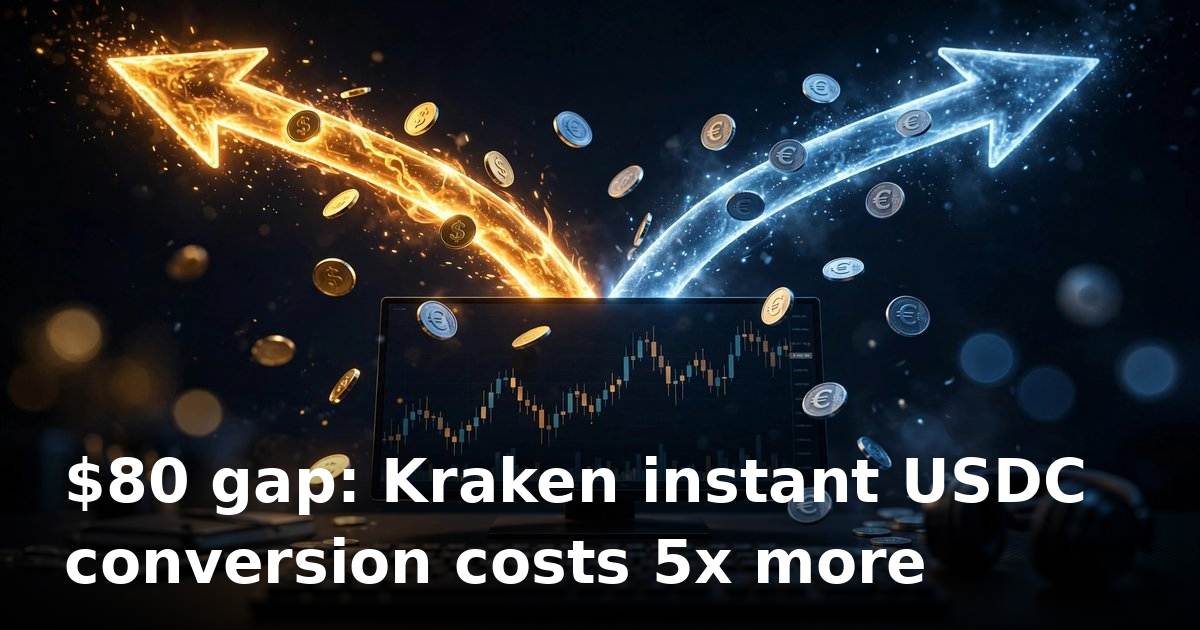

Two buttons, same trade, wildly different bills. A report published October 21 by CryptoSlate found that converting USDC into euros on Kraken can cost either 1% or 0.20%, depending on which button a user presses. The instant conversion path carries a 1% trading fee; routing the same swap through an eligible USDC/EUR order-book order drops it to 0.20%. On a $10,000 conversion, that is $100 versus $20 — an $80 gap for the exact same outcome.
The uncomfortable part is which price sits behind the default click. The instant button is the frictionless one, the one a new user reaches for without thinking — and it charges five times more than the alternative. The cheaper route asks the user to place a limit order against a live pair on Kraken Pro. Both rates are published on Kraken's own fee schedule, checked October 20, so nothing here is hidden. It is just buried in plain sight, one interface decision away from money most users never realize they left behind.
Small transfers tell a different story. On a $200 conversion, the gap shrinks to $1.60 — $2.00 instant against $0.40 through the book. At that size the percentage math fades and fixed costs take over: a SEPA payout runs about EUR1 through Bank Frick or Banking Circle, roughly $1.10, with a EUR2 minimum in some cases, while a route via ClearJunction lands near EUR0.90. Stack a EUR2 minimum payout on top of a $0.40 order-book fee and the fixed charge is five times the trading fee. Kraken rewards large conversions and quietly punishes small ones, which is exactly where dedicated payment apps price most aggressively.
Why it matters
This is the exchange business model laid bare. Exchanges do not hide their cheap route; they just price the convenient one like a luxury good. The 80-basis-point split matters to anyone using Kraken as an on/off ramp into euros — freelancers paid in USDC, traders rotating between stables and fiat, anyone who assumed a 1% fee was the market price. At five-figure sizes the gap dominates every other cost layer. A $10,000 instant conversion costs $100 before spread and withdrawal fees, against a Bank for International Settlements median of $40 to $60 for a $10,000 US-originated cross-border transfer (Working Paper 1385, published October 19, by Wenxin Du, Catherine Huang and David Scharfstein). The order-book route at $20 sits well below that median — before spread and payout costs, but still.
Kraken's European footprint makes the story bigger. The exchange expanded into EU banking and launched euro pairs and euro-adjacent products across the region, including the USDC vault product it rolled out this month. More euro users moving through Kraken means more users hitting this exact two-price problem.
What to watch
- Whether Kraken adjusts its instant pricing or surfaces the order-book route more prominently as scrutiny grows.
- How the GENIUS Act rule finalized October 21 reshapes stablecoin conversion and rewards economics at Kraken and rivals.
- The spread embedded in instant pricing: Kraken's own schedule notes instant trades carry a variable spread on top of the 1% fee, plus possible payment-method charges.
- Deposit holds: ACH deposits via Plaid carry a seven-day withdrawal hold; FedWire clears in zero to one business day — a real cost for anyone expecting same-day conversion.
MarketRadar take
MarketRadar computed the fee across trade sizes using Kraken's published rates, holding the entry-tier schedule constant:
| USDC amount | Instant (1%) | Order book (0.20%) | You keep extra |
|---|---|---|---|
| $200 | $2.00 | $0.40 | $1.60 |
| $1,000 | $10.00 | $2.00 | $8.00 |
| $5,000 | $50.00 | $10.00 | $40.00 |
| $10,000 | $100.00 | $20.00 | $80.00 |
| $50,000 | $500.00 | $100.00 | $400.00 |
The breakpoint logic is simple: above roughly $1,000, learning the order book is worth more than the effort costs; below $200, the payout layer — not the trading fee — decides which rail is cheapest. Note the limits of the math: the 0.20% figure is the entry-tier rate on stablecoin/FX pairs (maker and taker), volume tiers shift it, and the instant quote's embedded spread sits outside the 1% entirely, so the real gap can exceed 80 basis points on thin books. Directionally neutral — this is cost hygiene, not a market call. But for active stablecoin users, the cheapest euro on Kraken is a limit order away, and the expensive one is one click.