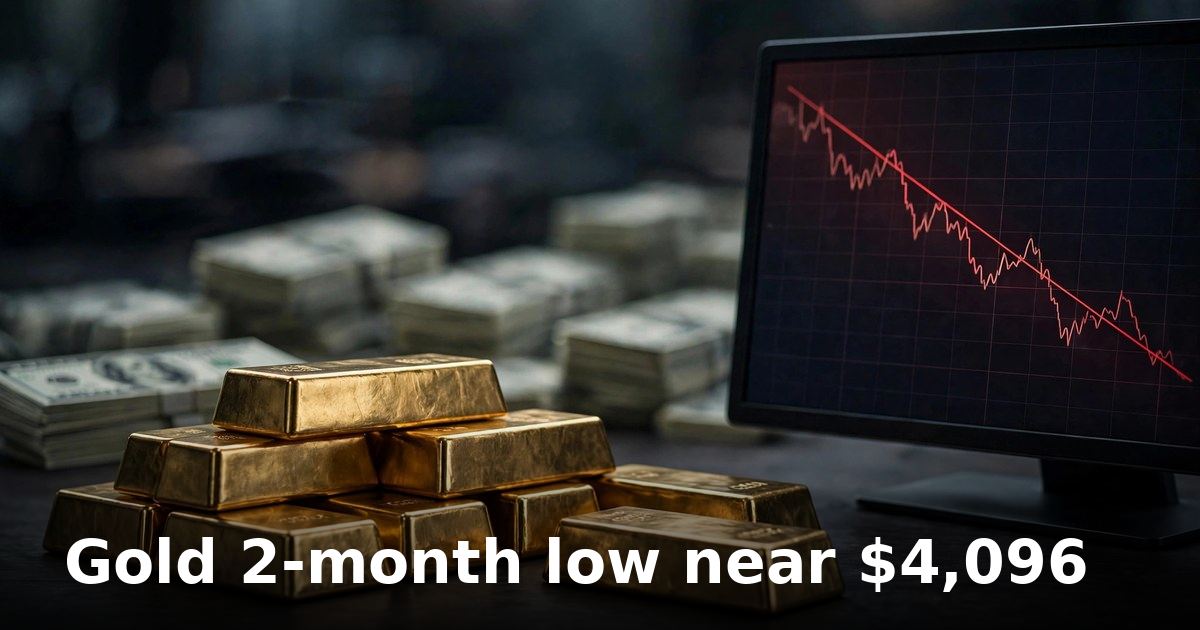

Gold lost its footing on Wednesday. By mid-morning in New York, spot gold was changing hands at $4,096.13 — a 1.6% slide and the softest quote since August 5. The benchmark dollar index climbed 0.7% in the same session, while the 10-year Treasury yield pushed past 5.3% to a level not seen in over 20 years, briefly touching a 24-year high near 5.36%.
December gold futures mirrored the move, sliding 1.6% to $4,121.70 on COMEX, and India's MCX December contract fell 0.52% to ₹1,49,340 per 10 grams. Late in the Asian evening the spot quote stood at $4,103.31, leaving the day's loss at $60.66, or 1.46%.
Two forces did the damage at once: a firm dollar making gold dearer for every buyer outside the US, and a 5.3%-plus risk-free rate making the metal's zero yield look expensive by comparison.
Why it matters
Gold has stopped trading like a geopolitical hedge and started trading like a duration instrument. War in the Gulf and Brent crude above $100 would normally lift the metal — this year those same forces have pushed inflation expectations, yields and the dollar higher instead, and the rate effect is winning. The metal is now down 6.2% over the past month and sits 26.8% below its $5,598 record from January 28.
The carry math is brutal. At $4,100 an ounce against a 5.3% 10-year yield, holding gold means walking away from roughly $217 a year in forgone yield per ounce. That arithmetic only works when the Fed's direction is friendly — and right now it isn't. Traders still price an 84% chance of another hike in December, even as the October meeting is expected to be a pause.
Tuesday had offered a flicker of hope: spot gold rebounded to $4,169.74 in New York morning trade after Monday's $4,140.47 close. But a single session of calm in the bond market — the 10-year merely easing to 5.27% — was all the relief on offer, and Wednesday's renewed yield spike erased the bounce in hours.
The one counterweight is official-sector buying. China's central bank stretched its monthly gold buying to 23 straight months in September, central banks bought a record 289 tonnes in the second quarter, and US-listed gold funds took in $3.8 billion in September even as the price fell. That demand has defended the $4,000 area on every test since June.
What to watch
- Fed minutes at 2 p.m. EDT (1800 GMT) — the September meeting ended in the first rate hike since July 2023, and the minutes showed the committee split over whether the increase was about energy-price insurance or demand-driven inflation. Any hint on December decides the near-term trend.
- The $4,100 line — a daily close below it opens $4,040 and then the $4,000 round number, where structural buyers are expected to show up. A close back above $4,230, the neckline of the head-and-shoulders pattern, targets $4,300–$4,330.
- China's buying streak — 23 months and counting; September's purchase came with the price sliding, the classic official-sector dip pattern.
- Silver's lead — silver shed 2.9% to $59.89 on Wednesday, a bigger drop than gold's. When silver leads down this hard, gold's weak hands usually follow.
| Level | Price | Context |
|---|---|---|
| Resistance | $4,230 | Head-and-shoulders neckline; close above targets $4,300–$4,330 |
| Pivot | $4,100 | Wednesday's battleground; -$60.66 day |
| Support 1 | $4,040 | Next downside marker |
| Support 2 | $4,000 | Held since June; Grant's downside target |
| Upside target | $4,400 | Zaner Metals year-end recovery case |
MarketRadar take
The path of least resistance stays down while the 10-year holds above 5.3% and the December hike stays 84%-priced — that's the higher-for-longer message keeping both the dollar and yields underpinned, in the words of Zaner Metals' Peter Grant. Near term, $4,100 is the pivot: lose it and the metal likely revisits $4,040 and then the $4,000 floor, which has absorbed every test since June.
The bullish case needs two things: the December hike odds to roll over, and a daily close above the $4,230 neckline. If both happen, Grant's $4,400 year-end recovery case comes back into play. Until then, this is a rates instrument, and the bond market is in charge.