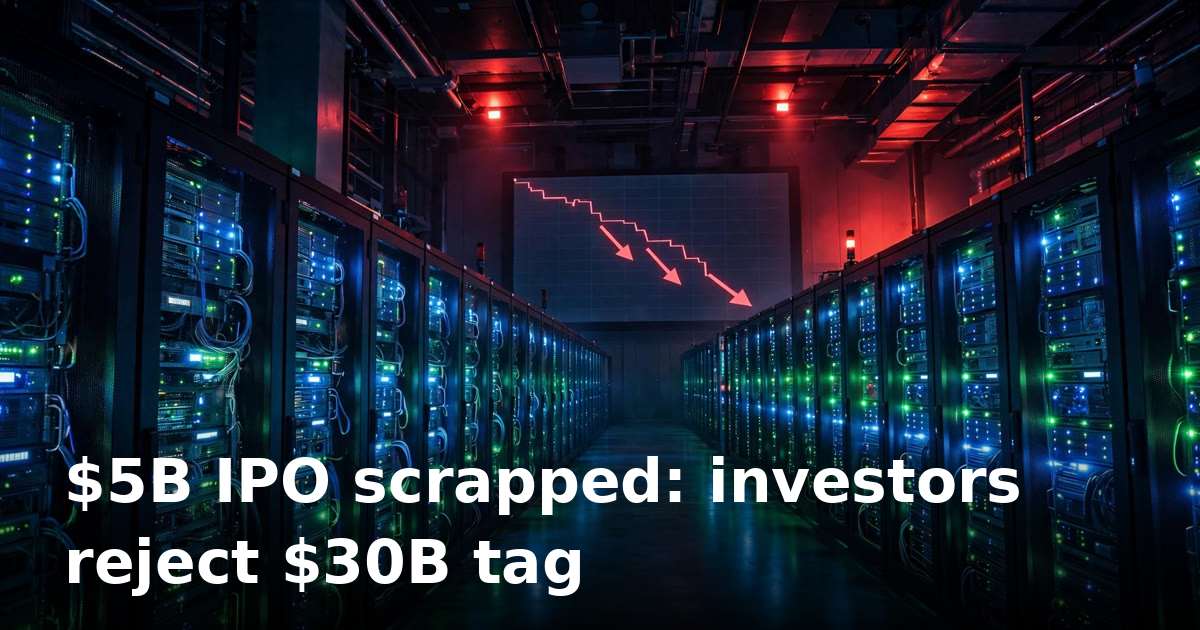

The money walked away on a Wednesday. Investors pulled their orders for Firmus Grid's planned $5 billion share sale, and by Friday the Australian data-center operator was out: no IPO, no ASX listing on October 22, no record raise. The deal had been marketed as the country's biggest initial public offering in nearly 30 years. Instead it became the clearest public-market rejection of an AI infrastructure valuation this year.
What killed it was the price tag. Firmus — an Australian company renting out AI compute built on Nvidia chips, with OpenAI and Meta Platforms among its customers — asked for a market capitalization of A$43.7 billion, roughly US$30 billion, after a private round that had priced it at US$10.5 billion only eight weeks earlier, when Blackstone and Coatue put in $2 billion. Then came Tuesday's lock-up disclosure: investors learned that pre-IPO holders would be free to unload a majority of their equity on day one of trading, and the bookbuild never recovered.
Two months, 2.9 times the valuation, and an escape hatch for insiders — that combination did the talking. John Pearce of Australian super fund UniSuper told the Wall Street Journal his fund passed on the deal: Firmus had a compelling story, he said, but not a compelling valuation. Portfolio manager Jun Bei Liu called the withdrawal an important reality check for the AI investment boom, pointing to how fast valuations had risen against the capital these businesses need.
Why it matters
This is a pricing story, not a demand story. Nothing in the withdrawal suggests AI computing demand is fading — Yardeni Research's Toby Hearst still argues demand for compute far outstrips supply. What changed is what public investors will pay for access to it. The AI trade sent the S&P 500 (7,812, +0.59% Friday) and Nasdaq (27,366, +0.64%) to records earlier this month, and Nvidia itself closed at $230.48 on October 8 with a $5.55 trillion market cap. Against that euphoric tape, a $5 billion IPO still could not find buyers. That tells you the tape is discriminating now. And this was not some small-cap gamble: the bookbuild was being run by a heavyweight syndicate — BofA, JPMorgan and Morgan Stanley among them, with local broker Morgans rounding it out — and the sale had been marketed as Australia's biggest float since Telstra's roughly $10 billion partial privatization back in 1997. When underwriters of that caliber cannot fill a book for the defining tech theme of the year, the problem is the price — not the product.
The arithmetic investors did is simple enough to run yourself. Firmus has two leased, operating data centers — one in Melbourne, one in Singapore — and five more in the pipeline across Australia, Malaysia and Indonesia. A $30.6 billion equity valuation on two live sites works out to about $15.3 billion per operating data center. Compare Nasdaq-listed CoreWeave: 51 facilities, a $37 billion market cap, roughly $0.73 billion per site.
Firmus was asking roughly 21 times the per-site valuation of its listed peer. That number is the whole story.
Then there is the debt. Morningstar's Lochlan Holloway put the future borrowing at roughly $30 billion once the buildout pipeline is finished — six times the $5 billion in 2028 operating earnings the company projects. A six-to-one debt-to-income ratio leaves almost no room for construction delays or a demand wobble. Credit, Holloway warned, sits at the center of essentially every boom-and-bust cycle. Note the asymmetry the prospectus itself revealed: Reuters reported Firmus expects to post a $77M loss for the half-year ending June 30, 2027, sitting beside that $5 billion earnings projection. Investors were asked to pay for 2031 earnings with 2026 money, and this week they declined.
| Metric | Firmus (IPO ask) | CoreWeave (listed) |
|---|---|---|
| Valuation | ~$30.6B | $37B |
| Operating sites | 2 (leased) | 51 |
| Valuation per site | ~$15.3B | ~$0.73B |
| Planned sites | 5 | — |
| Outcome | IPO withdrawn Oct 9 | Shares fell ~8% Thursday |
What to watch
- Anthropic's planned blockbuster IPO, roughly a month out, is now the next test of public appetite for AI listings. Its reception will say more about this repricing than any analyst note.
- Firmus said it will raise privately instead; a person familiar with the matter told Bloomberg a Nasdaq listing could come later. Private rounds do not require the market's permission — watch the terms.
- Nvidia is a backer (7.2% stake), customer, and hardware supplier to Firmus. The chipmaker's $5.55 trillion valuation rests partly on exactly this kind of infrastructure buildout. Watch NVDA's reaction trade.
- CoreWeave's shares dropped nearly 8% on Thursday on worries about AI-company profitability. If the listed neoclouds keep sliding, private round valuations follow.
MarketRadar take
Treat this as a repricing signal for the whole neocloud complex, not a one-company event. When a company can triple its valuation in two months on private money and then fail to clear the public market, the gap between private AI pricing and public AI pricing is the trade. The read is bearish for upcoming AI-infrastructure listings and cautious on the neocloud segment until one of these names prints public-market acceptance — Anthropic's IPO is the next data point. CoreWeave, the closest listed comparable at 51 facilities and a $37 billion market cap, is the canary: its ~8% slide on Thursday says the listed side of this trade is already adjusting. No advice here — just arithmetic: $15.3 billion per operating data center did not survive contact with a public order book.