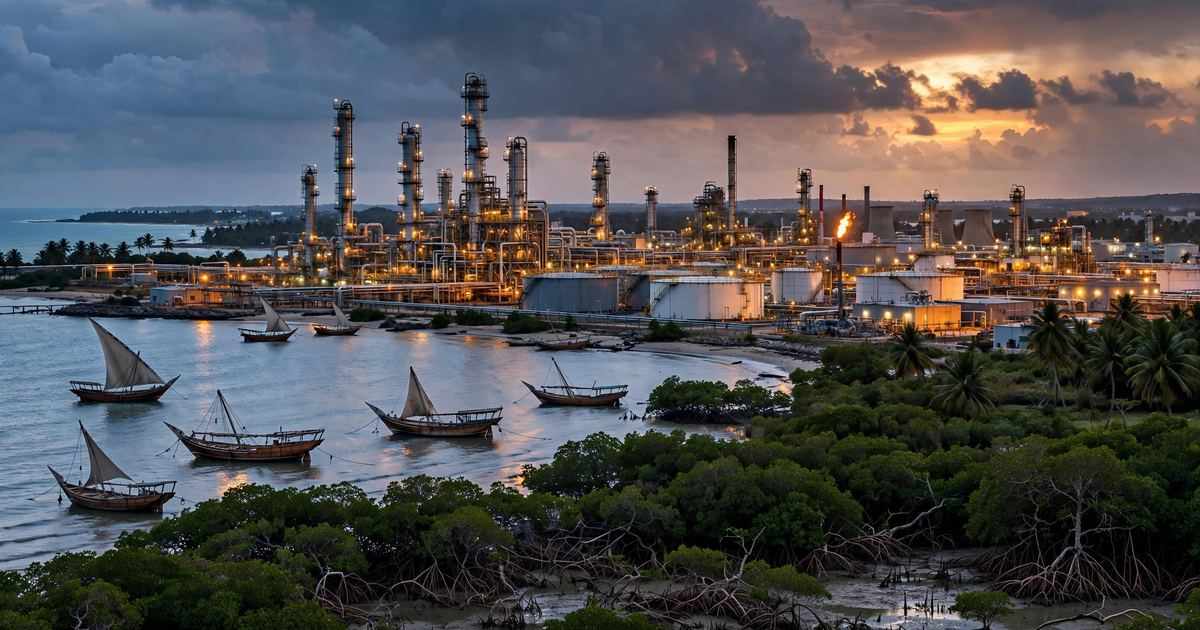

Aliko Dangote has broken ground on a mega-refinery at Lamu on Kenya's Indian Ocean coast, a $15 billion project — $16 billion by AFP's estimate — that would take in 700,000 barrels of crude every day. The ground-breaking ceremony on September 30, attended by Kenyan President William Ruto and regional leaders, came days after a Kenyan court lifted a late-September order pausing construction, clearing the way for a project aimed at making East Africa far less dependent on refined fuel shipped from the Gulf.
The refinery would sit across the bay from Lamu Old Town, a 700-year-old Swahili port and UNESCO World Heritage site, and has already drawn lawsuits from more than 100 local residents over ancestral land, plus objections from Greenpeace and tourism operators worried about mangroves, coral reefs and fishing grounds. Kenyan officials say the plant would deliver energy security, cut Gulf import reliance and create 60,000 roles through the building phase and once the plant is running, with the government taking an equity stake.
Dangote Industries has started soil tests and begun ordering equipment, with Devakumar V.G. Edwin, a senior executive at Dangote Industries, saying the company wants to move "on a fast-track basis." The plan is to import crude from Nigeria, the United States, Brazil, Libya, Angola and Ghana, then ship finished fuels out of the Lamu harbor already in place, which it intends to enlarge.
Why it matters
East Africa imports nearly all of its refined fuel from the Gulf, a supply chain routed through the Strait of Hormuz — the same chokepoint where disruptions from the US-Iran war have already rattled markets this year. Crude was trading firmly into the weekend on that risk: WTI closed Friday at $91.11, down 1.9% on the day after an intraday dip to $88.06, while Brent fell to $98.43 intraday before recovering to close at $102.25 — a Brent-WTI spread of roughly $11.14, the kind of wide premium that appears when Hormuz-linked supply anxiety is priced into seaborne barrels.
A 700,000-bpd refinery that buys Atlantic Basin crude and sells finished fuel locally attacks that dependency from both ends: it bids for crude from Nigeria, Brazil, Angola and Ghana — new structural demand in those streams — while shrinking the region's need for Gulf-sourced diesel, jet fuel and gasoline. Dangote's track record gives the plan credibility: his $20 billion refinery outside Lagos hit full capacity in February and, at full run, now turns out diesel, aviation fuel and petrol for world markets without needing passage through Hormuz or Bab el-Mandeb. He plans to double that plant to 1.4 million bpd, and in September began selling shares in it to bring in $1.6 billion from as many as 10 million backers.
The competitive backdrop is sharpening too. Uganda and Tanzania unveiled plans for a competing $20 billion refining and energy complex at Tanzania's Tanga port in August, and Uganda is close to pumping its first crude in the weeks ahead through a TotalEnergies-built pipeline. For more context on where energy sat heading into the weekend, see our weekend commodities outlook, and for how oil volatility is already feeding through to regional equities, the KSE-100 selloff on oil jitters.
What to watch
- The land-rights case: a court ruling let ground-breaking proceed, but the underlying lawsuit from Lamu residents continues.
- UNESCO's verdict: the agency has asked Kenya for information and says the refinery's compatibility with Lamu Old Town's World Heritage status must be assessed for potential impacts.
- Security: al-Shabaab remains active near the coast; the project's logistics corridor passes close to Manda Bay naval base, attacked in 2020.
- Crude sourcing: initial runs will lean on Middle East and US barrels, with African supply growing as Kenya and Mozambique develop production.
- The Tanga rival: Uganda and Tanzania's competing $20 billion hub could split regional crude and refined-product flows.
- Hormuz: any further disruption to the strait raises the value proposition of a refinery that skips it entirely.
Key points
| Project | Location | Capacity | Cost | Status |
|---|---|---|---|---|
| Dangote Lagos | Nigeria | 650,000 bpd → 1.4M planned | $20B | Full capacity since Feb 2026 |
| Dangote Lamu | Kenya | 700,000 bpd | $15B (WSJ) / $16B (AFP) | Soil tests, equipment ordered |
| Tanga hub | Tanzania | undisclosed | $20B | Announced Aug 2026, details sketchy |
- Lamu refinery: 700,000 barrels per day — a throughput bigger than anything currently operating in Europe (AFP).
- Target completion: about 30 months from ground-breaking, with a 1,000 MW power plant attached, half feeding Kenya's grid.
- Lamu port handled twice as much cargo in the first half of 2026 as in all of 2025, as Gulf-bound cargo was diverted by Hormuz disruptions.
- Kenyan government holds an equity stake; 60,000 jobs promised across construction and operations.
MarketRadar take
The directional read here is modest but real: a 700,000-bpd refinery that sources most of its crude from Atlantic Basin exporters is a new standing bid for Nigerian, Brazilian, Angolan and Ghanaian barrels — mildly supportive for crude demand in those streams once the plant nears start-up. It is not a crude price catalyst on its own; refinery projects build refined-product supply, not oil scarcity. The bigger near-term signal for oil markets is the context, not the concrete: a Brent-WTI spread north of $11 and Gulf cargo being diverted to Lamu both say the market is still pricing a Hormuz risk premium. Watch the land case, the security picture and whether the Tanga rival materializes — whichever plant moves first will set East Africa's fuel trade map for the next decade.