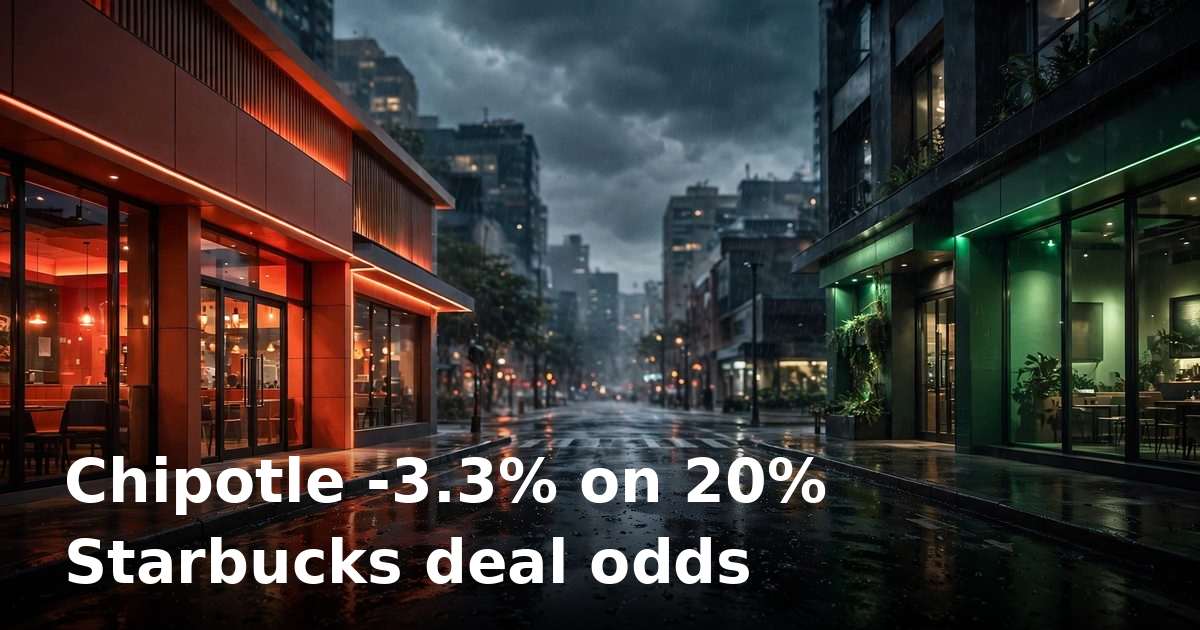

Thursday's takeover euphoria didn't survive the night. Chipotle Mexican Grill shares dropped 3.3% on Friday while Starbucks slid 1.5% intraday, as Wall Street analysts spent the morning tearing apart the report that Starbucks had quietly worked with advisers on a takeover of the burrito chain. The Financial Times broke the story on October 8: Starbucks had explored a proposal with advisers over recent months, though it could not establish whether a formal offer was ever made, and people close to the talks cautioned the deal might never happen. Two days earlier, Semafor had reported Chipotle retained bankers to guard against a possible suitor. The target was already bracing for a bidder — and Thursday's 6.2% pop was the market's first guess at what the premium might be.
That context matters. On Thursday, Chipotle jumped 6.2% — touching an 8% intraday spike — while Starbucks dropped 4.4% early before clawing back to roughly flat. The move valued Chipotle at about $41 billion against Starbucks' roughly $107 billion. A bid at any premium would make it the largest restaurant acquisition on record, dwarfing Burger King's $11.4 billion purchase of Tim Hortons in 2014.
DA Davidson's Matt Curtis was the catalyst for Friday's fade. He estimated only about a 20% probability the deal gets completed, kept a Neutral rating on Starbucks with a $110 price target, and noted there is "limited obvious overlap" between the two businesses. The one concession: Chipotle could gain access to Starbucks' infrastructure and operating expertise.
One in five. That's the market's new math for the biggest restaurant deal ever attempted — and it explains the entire Friday tape.
He's not alone in the skeptics' corner. TD Cowen's Andrew Charles called it a low-probability outcome, arguing that chasing an acquisition potentially worth more than $44 billion clashes with CEO Brian Niccol's focus on Starbucks' U.S. turnaround. RBC questioned the strategic rationale outright: general and administrative plus supply-chain savings would be real but insufficient, and a megadeal could pull management's attention away from the recovery just as the numbers are turning.
Stephens' Jim Salera went the other way, pointing to shared real-estate development and operating efficiencies — the median Chipotle sits about 0.18 miles from the nearest Starbucks, he noted — plus customer overlap that could feed a broader rewards platform and consumer-data engine. It was the lone bullish voice among the Friday notes, and it rested entirely on operational overlap, not on the deal being likely.
Starbucks itself said nothing new. Responding through a statement to the Wall Street Journal on Thursday, the company declined to comment on rumors and said it was "concentrating fully on the "Back to Starbucks" turnaround plan," adding it had strong momentum and confidence in long-term growth. That silence reads as deliberate: Niccol has been rebuilding the brand for two years with at least $500 million committed to labor investment, and the company has now posted four consecutive periods of same-store sales increases.
Why it matters
This is the biggest potential restaurant deal ever discussed, and the market is treating it as a coin flip at best. The numbers framing the debate are stark. Starbucks' adjusted operating margin was 14.4% in the fiscal third quarter, down from 16.7% two years earlier, per LSEG data cited by Reuters. Heavy borrowing or share issuance would be needed to swallow Chipotle, and eToro's Lale Akoner warned investors may read it as an "expensive distraction" without a compelling financial case. The stock's 2026 tape tells two stories: Starbucks is up about 8% year-to-date, while Chipotle has lost more than 16%.
In other words, the premium looks tasty precisely because the burrito chain is beaten down — which also explains why the rumor alone moved the stock 8% intraday.
The human thread is what keeps the story alive. Niccol ran Chipotle for six years from 2018 before taking the Starbucks job in 2024, and the chain has shed roughly 40% of its value since he left. Northcoast Research's Jim Sanderson argued Starbucks' licensing network across Europe might finally widen Chipotle's thin international footprint — about 100 locations outside the U.S., with first stores in Mexico and Saudi Arabia this year and a joint venture with Korean food company SPC Group from last year. That's the bull case for the deal, and it rests on one man's Rolodex. Neither company has confirmed any bid, and with Chipotle's defenses up while Starbucks publicly recommits to its own turnaround, the market is left trading headlines — which is exactly why Friday belonged to the skeptics.
What to watch
- October 28: Chipotle reports third-quarter results — the first hard data since the takeover report broke.
- October 29: Starbucks reports fiscal fourth-quarter and full-year 2026 results and its next fiscal-year outlook, after the market close.
- Any regulatory or banker movement: no formal offer has been confirmed; Semafor's banker-hiring report suggests Chipotle is preparing defenses, not negotiating.
- The turnaround proof: whether Starbucks' fourth quarter shows the margin improvement analysts like Annex's Brian Jacobsen are waiting for before buying the megadeal logic.
MarketRadar take
The market has priced the deal as a long shot, and the analysts are right to do so. A $41 billion target against a buyer still mid-turnaround, with margins thinner than two years ago and $500 million already committed to labor, is a financing stretch — TD Cowen's $44 billion-plus figure is the right lens, not the $41 billion headline.
| Deal math | Figure |
|---|---|
| Chipotle market value (post-rally) | ~$41B |
| Starbucks market value | ~$107B |
| TD Cowen's deal-value estimate | >$44B |
| Largest restaurant deal ever (2014, BK/Tim Hortons) | $11.4B |
| Thursday move: CMG | +6.2% (8% intraday high) |
| Friday intraday move: CMG | -3.3% |
| Friday intraday move: SBUX | -1.5% |
| DA Davidson's completion odds | 20% |
The real catalyst is now the calendar: two earnings reports, fourteen days apart, and not a single confirmed offer between them.
The cleaner trade here is the waiting game, not the takeover lottery. Chipotle reports October 28 and Starbucks on October 29 — two weeks of earnings will tell us more about both companies' standalone trajectories than any rumor. If Chipotle's numbers are weak, the "takeover put" keeps a floor under the shares; if they're strong, the stock doesn't need the deal. For context on how restaurant and consumer names are trading into earnings season, see our recent coverage of Tesla's delivery beat and the Nasdaq's fourth straight week.