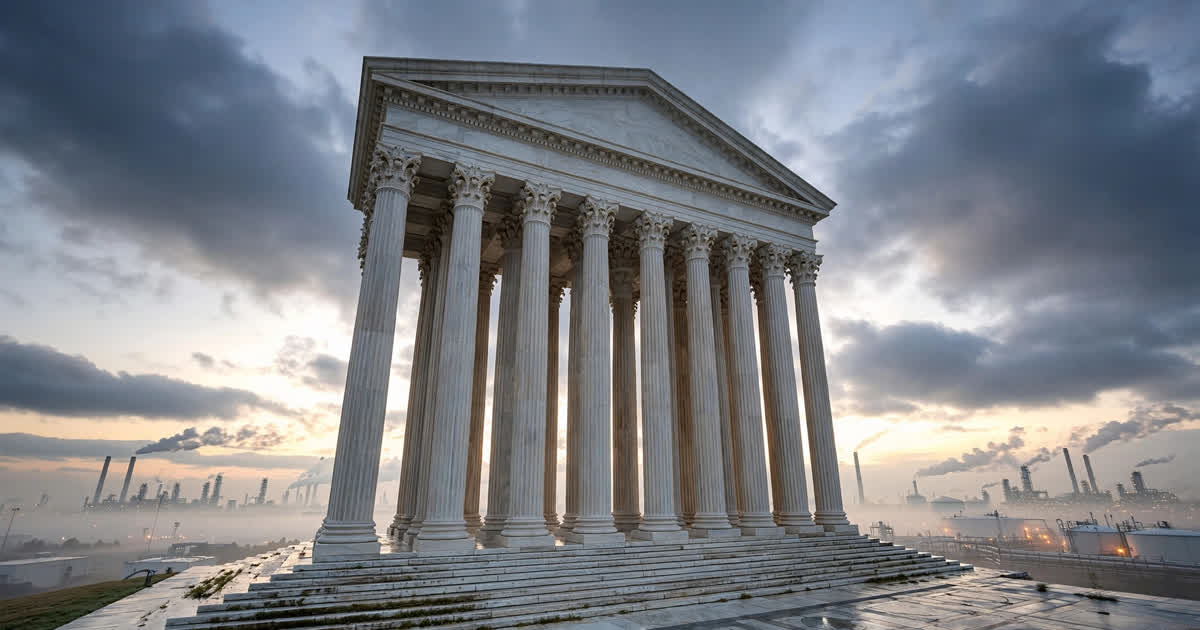

The Supreme Court starts its nine-month term on Monday — and the first case on the docket could reshape climate liability for the oil industry. ExxonMobil and Canada's Suncor Energy want the justices to throw out a damages lawsuit brought by Boulder, Colorado, a case that has become the test balloon for dozens of similar actions against the fossil-fuel sector.
Boulder city and county filed the suit back in 2018. Their core claim: the two producers accelerated climate change and kept the public in the dark about what their products were doing. What they are asking for is money — for damage already done and costs still coming, from washed-out infrastructure and wildfire response to strains on public health. On the defense side, the argument runs that emissions regulation belongs to Washington, not state courts: Congress already occupied this ground when it empowered the EPA under the Clean Air Act, so Colorado tort law has no room to operate.
One county's case is the tip of a much larger wave. Court filings from the companies count close to 60 comparable actions brought by state and local governments, chasing what Reuters describes as billions in damages — and a win here could knock many of them out at once. Washington is on the companies' side: the Trump administration told the Court that Boulder's claims are barred under federal law.
Why it matters
For energy investors, this is a tail risk with a nine-month fuse. Oil companies have spent years litigating whether these cases even get to trial; a Boulder victory would open the door to trials and higher legal costs across the sector, while a company win would remove a legal overhang that has hung over the majors through multiple cycles. The timing adds another layer: crude is already repricing supply risk after a volatile Friday, and investors who track the energy side of the market now have a second, unrelated exposure to model. A related read on how legal and regulatory shocks move broader equity benchmarks is worth keeping in view.
What to watch
- Monday's arguments (Oct 5): the case is the first argued of the new term — the court's practice is to begin each term on the first Monday of October.
- The 4-4 question: Justice Samuel Alito recused himself on Sept 28, citing no reason publicly; his filings list stakes in various oil and gas producers — just not Exxon or Suncor themselves, Reuters has reported. With eight justices sitting, a 4-4 split would leave the Colorado ruling standing without setting a national precedent.
- The preemption argument: the companies say claims over interstate and international emissions are barred by federal law; Boulder counters that this is local harm pursued under local law — compensation, not emissions regulation.
- The June 2027 decision: rulings from this term traditionally land by late June — the amici stack already tells the story: states, cities, manufacturers, former federal officials, climate economists and environmental groups have all filed briefs, a measure of how widely the ruling's logic will travel, including to state "climate Superfund" laws.
MarketRadar take
We compiled the case's path to Monday into one timeline — every step below is verified across the legal and news record:
| Date | Milestone |
|---|---|
| 2018 | Boulder city + county sue Suncor and Exxon under Colorado law (public nuisance, trespass, unjust enrichment, conspiracy) |
| May 2025 | Colorado Supreme Court, 5-2: federal law does not preempt the claims |
| Aug 2025 | Suncor and Exxon petition for certiorari |
| Feb 23, 2026 | Supreme Court grants review; adds a jurisdiction question for both sides to brief |
| Sept 28, 2026 | Justice Alito recuses himself |
| Oct 5, 2026 | Oral arguments, opening day of the new term |
| By end of June 2027 | Decision expected |
Three things stand out in the numbers. First, the scale: "nearly 60" parallel suits seeking "billions" makes this the single largest coordinated liability threat the sector has faced — the legal equivalent of the supply shocks that had Brent trading at $102.25 into Friday's close. Second, the Court took an unusual step in ordering briefing on its own jurisdiction, which legal analysts read as the justices keeping open the option of a narrow, case-specific ruling rather than a sweeping preemption holding. Third, the 6-3 conservative majority does not automatically decide it: the Alito recusal and the federalism dimension (states' right to run their own tort law) scramble the usual alignments. Watch Monday's argument transcript for how much time the justices spend on the jurisdiction question versus the merits — heavy jurisdiction time favors the narrow outcome, and the narrow outcome keeps the liability cloud over the sector into 2027.